




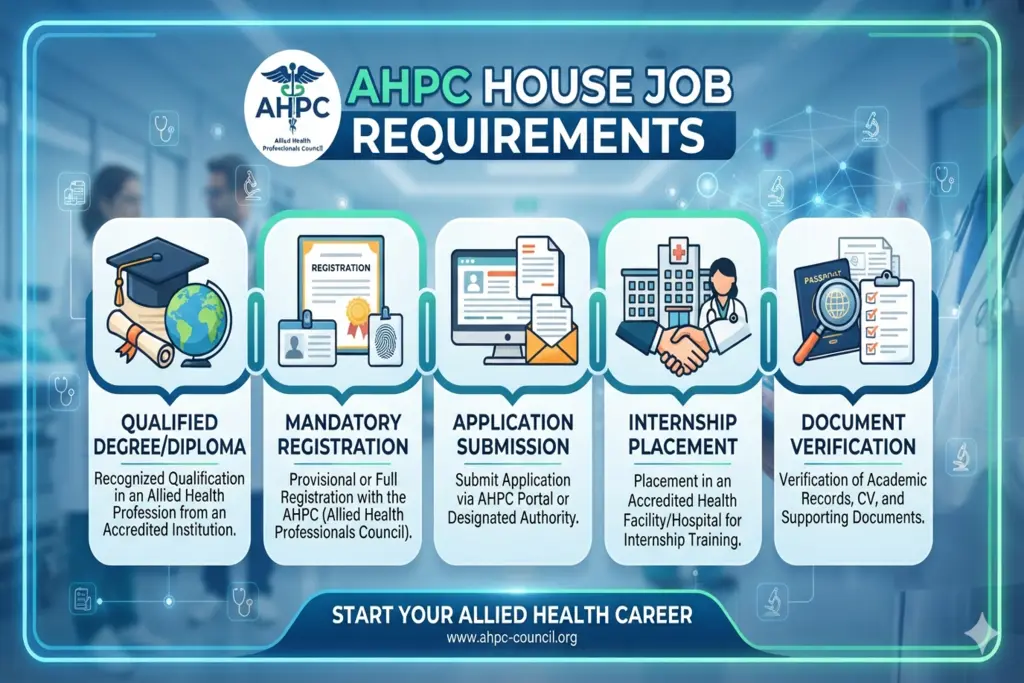
There has been a revolution in Allied Health Sciences in Pakistan. The Allied Health Professionals Council (AHPC), under the Ministry of National Health Services, Regulations and Coordination (NHSR&C) has officially regularized the post-graduate structure for medical technologists and therapists. Clinical training is no longer an option, but a mandatory requirement by law. For fresh graduates aiming to legally practice within the national healthcare system, fully understanding the core AHPC House Job Requirements is crucial to securing professional licensing and avoiding career disruptions.
AHPC House Job Mandatory Durations and Eligibility Criteria
The AHPC structure has clearly categorized clinical training based on the academic span of the undergraduate degree. The duration of the house job is determined by whether the graduate holds a 4-year or a 5-year degree:
For 4-Year BS Program Graduates: All professionals completing a 4-year Bachelor of Science degree—such as BS Medical Laboratory Technology (MLT), BS Medical Imaging Technology (MIT), Optometry, or Anesthesia Technology—must complete 06 months of continuous clinical house job training.
For 5-Year Professional Degree Graduates: Those holding a 5-year professional doctorate or bachelor’s degree, most notably the Doctor of Physical Therapy (DPT), are legally required to undergo 01 full year (12 months) of clinical house job training.
During this structural timeline, trainees are legally designated the professional title of “House Officer” within their respective hospital departments.
AHPC House Job Crucial Licensing Prerequisite
The most critical change implemented by the council involves professional accountability. The AHPC has declared that the successful completion of a verified house job is an absolute mandatory prerequisite for getting a professional license.
Without an active AHPC practitioner license, an allied health graduate cannot legally practice, run independent clinical labs, or seek employment in either private or public sector hospitals. Completing this training at a council-approved facility is the only way to validate your degree.
AHPC House Job Essential Documentation Checklist
To apply for a professional clinical registration and license post-training, graduates must submit a comprehensive dossier to the AHPC portal. The fundamental documentation requirements include:
Attested Higher Education Degree: Your official university transcript and degree certificate, fully attested by the Higher Education Commission (HEC) of Pakistan.
Basic Academic Certificates: Matriculation/O-Level and F.Sc. Pre-Medical/A-Level equivalence certificates.
National Verification: A valid, clear color copy of your Computerized National Identity Card (CNIC).
The official completion Certificate will be issued and signed by the Medical Superintendent (MS) or the Head of Department (HOD) of a teaching hospital.
Biometric Photos: Recent passport sized photos, taken against plain white or blue background.
AHPC House Job Practical Advantages for Graduates
This regularized structure is an additional step after graduation, but it takes the entire cadre of Allied Health Professionals in Pakistan to a new level of professional benefits:
Clinical Autonomy & Identity: It provides a clear corporate hierarchy for allied health and nursing professions, and provides allied health professionals with a recognised clinical identity as well as their traditional counterparts.
Hands-on Competency: It connects academic textbooks and real life clinical pathology, handling and advanced operation of medical machines.
International Equivalency: There are strict requirements for validated clinical training hours in the global healthcare market, especially in the Middle East (UAE and KSA) and Western countries (UK and USA). This structure allows for easy avenues through which immigrants and foreign workers can come in.