




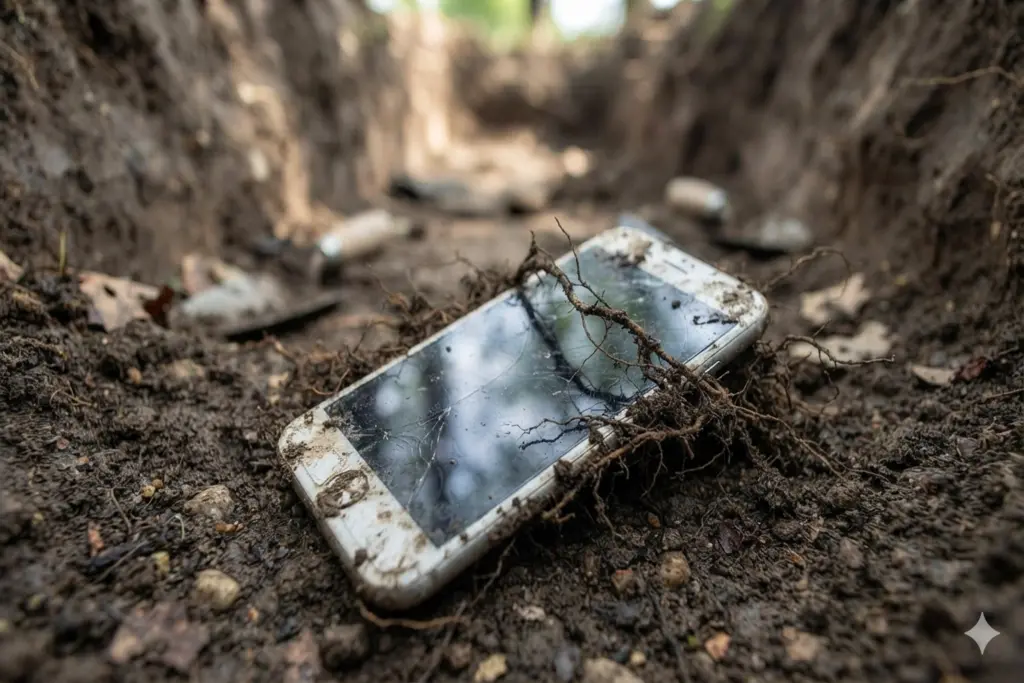
Modern smartphones are built to last for years not centuries. If you buried an iPhone today and dug it up 250 years later, it would almost certainly be unrecognizable. Moisture, soil chemistry, bacteria, pressure, and corrosion would slowly destroy nearly every component.
Here’s what scientists say would happen over time.
The Battery Would Break Down First
The lithium-ion battery is one of the most vulnerable parts of an iPhone. Over time, it would corrode, leak chemicals, and completely lose its ability to store energy. In some conditions, the battery casing could rupture long before the rest of the phone decomposes.
Metal Parts Would Rust and Corrode
Although iPhones use corrosion-resistant materials such as aluminum, stainless steel, and titanium in some models, constant exposure to moisture and minerals in the soil would gradually corrode metal components. Tiny screws, connectors, and internal circuits would deteriorate until they no longer function.
The Screen Would Crack and Separate
The display glass may survive longer than many internal parts, but pressure from the surrounding soil and temperature changes could cause it to crack. The display layers and adhesives would also separate and degrade over time.
Plastic and Rubber Components Would Decay
Seals, cables, insulation, and plastic parts would slowly become brittle and break apart. Microorganisms and chemical reactions in the soil would speed up the deterioration.
The Processor and Memory Would Stop Working
The microscopic electronic circuits inside the phone would corrode as moisture reached the chips. Even if the chips remained physically intact, the stored data would almost certainly become unreadable after centuries underground.
Would Anything Remain?
After 250 years, you might still find fragments of glass or pieces of the metal frame, depending on the soil conditions. However, the iPhone would no longer resemble a working device, and recovering any usable data would be extremely unlikely.
Conclusion
An iPhone buried for 250 years would be almost completely destroyed by corrosion, moisture, and natural decomposition. While a few durable materials like glass or metal fragments might survive, the battery, electronics, screen, and internal components would all fail long before then. The experiment highlights how even advanced technology eventually breaks down when exposed to nature for long periods.
FAQs
Q: Would an iPhone still work after 250 years underground?
A: No. The battery, electronics, and internal circuits would have completely deteriorated.
Q: Which part would fail first?
A: The lithium-ion battery would likely degrade first due to chemical breakdown and corrosion.
Q: Could scientists recover data from it?
A: After 250 years underground, recovering usable data would be extremely unlikely.
Q: Does soil type affect decomposition?
A: Yes. Moisture, acidity, temperature, and oxygen levels all influence how quickly materials break down.