


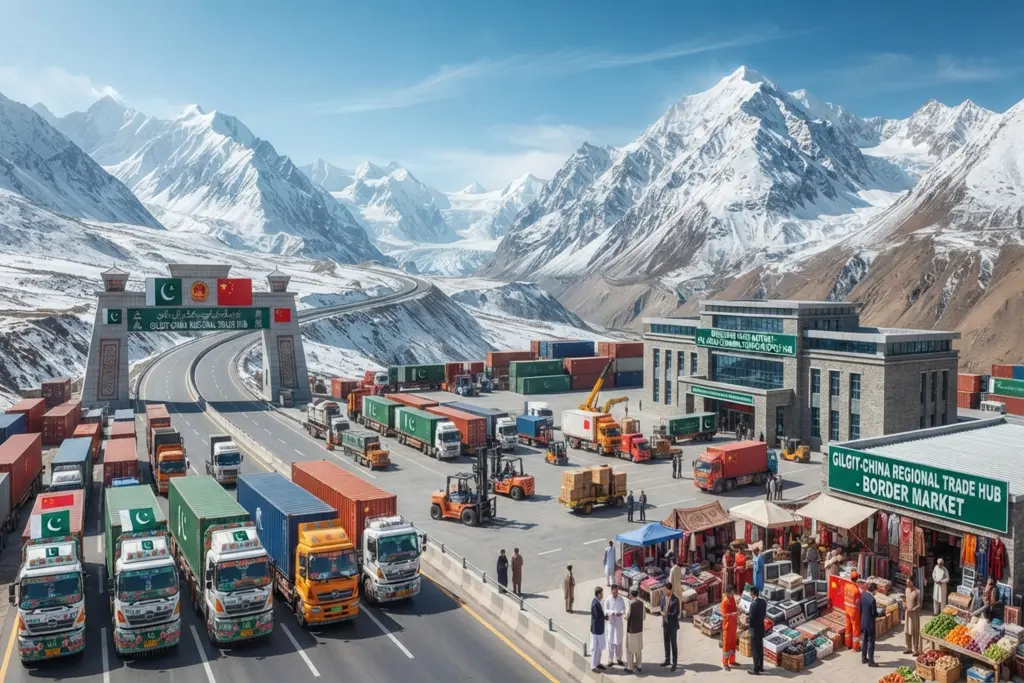
The Government of Pakistan has officially opened the gates of a grand strategic plan to make the Sost Dry Port and the Khunjerab Pass at the border of Pakistan and China a modern and technology driven regional trade hub. Federal Minister for Planning, Development, and Special Initiatives, Professor Ahsan Iqbal, has issued an official directive to the National Logistics Corporation (NLC) to expedite the project of the Sost Dry Port on an emergency basis. The objective of this project is to significantly boost national exports, reduce the customs delays and clearances and ensure that northern Pakistan becomes the main overland logistics transit corridor for Western China and Central Asia.
Infrastructure Modernization and Digital Expansion at Sost Dry Port
Under the newly finalized federal action plan, cross-border infrastructure at the Khunjerab Pass and the Sost checking points will undergo systemic upscaling to match international cargo standards. Federal Minister Ahsan Iqbal emphasized that a highly efficient, automated, and digitally integrated logistics ecosystem is critical to stabilizing Pakistan’s economy through enhanced trade flows.
The primary structural enhancements mandated under the project include:
Automated Port Management: Adopting new web-based customs platforms and biometric screening to phase out paperwork delays and fight under-invoicing.
Cold-Chain Warehousing Facilities: Building up modern cold chain warehouses to protect agricultural perishable exports and imports.
Linguistic and Technical Upskilling: Setting up specialized training institutes to teach the Chinese and Central Asian languages to local logistics workers and youth, optimizing trade communication.
A Stable Alternative Route Connecting to Central Asia
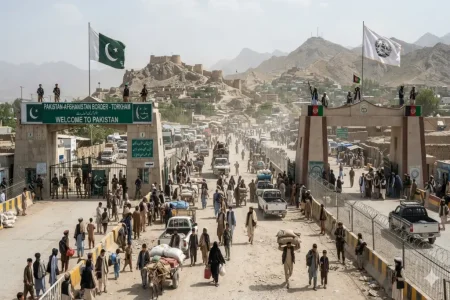
The geopolitical significance of the Gilgit-China border expansion has spiked significantly due to prolonged and volatile border closures along Pakistan’s western frontier with Afghanistan.
To overcome these enduring obstacles, Islamabad has been making an active effort to keep the Khunjerab-Sost roadway as a very reliable overland trade route to reach the Landlocked Central Asian Republics (CARs) such as Kyrgyzstan, Kazakhstan and Uzbekistan directly from Pakistan.
Commercial truck convoys from Kyrgyzstan have been able to successfully pass through China in compliance with the Quadrilateral Traffic in Transit Agreement (QTTA) and the Transports Internationaux Routiers (TIR) convention to enter Pakistan through the Sost Dry Port. This operational transit corridor is essentially around Afghan territory, providing the Central Asian economies with an unimpeded and secure highway layout down to deep sea ports of Karachi and Gwadar.
Economic Stimulus and Local Business Incentives
The upgrade comes as a major relief to the local trading community in Gilgit-Baltistan, who previously staged protests and strikes against complex customs regulations and multi-tiered taxation. Addressing these internal grievances, the federal government has institutionalized specific tax exemptions and simplified clearance policies on essential commodities consumed within Gilgit-Baltistan.
Recent clearance reports indicate that despite extreme weather challenges, the Sost Dry Port has collected record-breaking billions in customs revenue. The federal administration anticipates that cementing the Sost Dry Port as a fully functional regional trade hub will not only supercharge Phase-II of the China-Pakistan Economic Corridor (CPEC) but will also stimulate grassroots economic growth, eco-tourism, and job creation across northern Pakistan.