




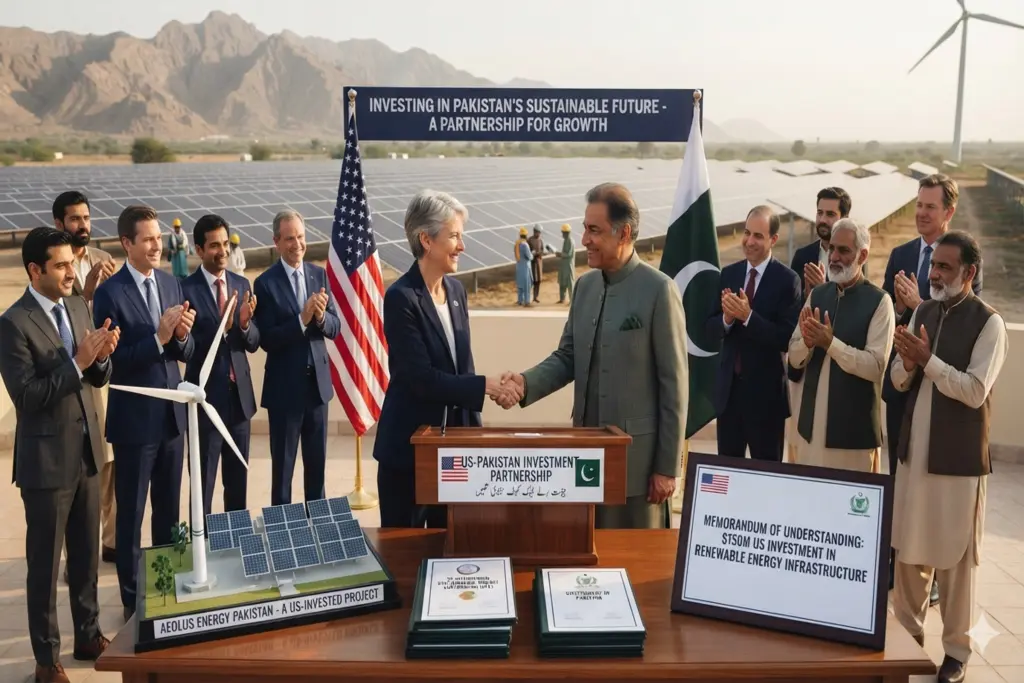
Pakistan has officially resumed its efforts to bring in strong American corporate and institutional capital in its high growth sectors in order to achieve long-term stability in the macroeconomic system. A high-level bilateral meeting was held between the top businessmen of the two countries where they presented selected investment opportunities and started to shift the bilateral relationship from a historical geopolitical dependency towards a more balanced and mutually beneficial ‘geo-economic’ partnership.
High-Priority Sectors Primed for American Capital
Pakistan has laid out structured frameworks across specific tech-heavy and resource-rich sectors where US corporate capabilities align with local market demand:
1. Information Technology and Artificial Intelligence
The digital ecosystem in Pakistan is undergoing an exponential transformation and the third-largest English-speaking freelancer workforce is supporting the evolution. The government is encouraging American tech giants to set up regional delivery points, invest in AI infrastructure and use local engineers for scalable software development for the world.
2. Agriculture and Agri-Tech Solutions
The agriculture sector contributes almost 25% of the GDP of Pakistan and needs modernisation to overcome challenges faced due to climate change. To transform the production and processing of crops, precision farming technology, cold-chain logistics and advanced seed biotechnology are being fast-tracked through joint US-Pakistan agronomic webinars in the country.
3. Green Energy and Sustainable Mining
To reduce reliance on expensive fuel imports, Pakistan is pivoting toward renewable energy. US firms are being invited to invest in large-scale wind and solar grids. Furthermore, Pakistan’s untapped mineral deposits—specifically copper, gold, and lithium—present immediate, high-value opportunities for US mining and refining infrastructure.
Current Trade Volume and Emerging Frameworks
The United States remains Pakistan’s largest single export destination. Recent economic indicators highlight the current depth and future potential of this commercial partnership:
| Trade Indicator | Volume & Target Metrics | Core Strategic Focus |
| Total Bilateral Trade | Approx. $8.7 Billion | Joint target to scale this volume to $20 Billion within five years. |
| Pakistan Exports to US | $5.4 Billion | Dominated by premium textiles, surgical instruments, and IT services. |
| US Exports to Pakistan | $3.3 Billion | Primarily high-grade cotton, soybeans, and heavy industrial machinery. |
| Reciprocal Trade Framework | Active Bilateral Negotiations | Streamlining regulatory compliance to offer easier market access for exporters. |
Economic Reforms and Investor Protection Guarantees
The Ministry of Finance has implemented strict structural, fiscal and regulatory reforms to regain the confidence of investors from abroad. Under the IMF’s discipline, Pakistan has managed to normalize its foreign exchange position, keep inflation under check and reduce fiscal deficits.
The government is striving to work with the U.S. International Development Finance Corporation (DFC) to tackle private sector investment and reduce political risk. Bureaucratic red tape has been aggressively trimmed by routing foreign investments through streamlined, single-window approval operations to ensure rapid deployment of capital.