


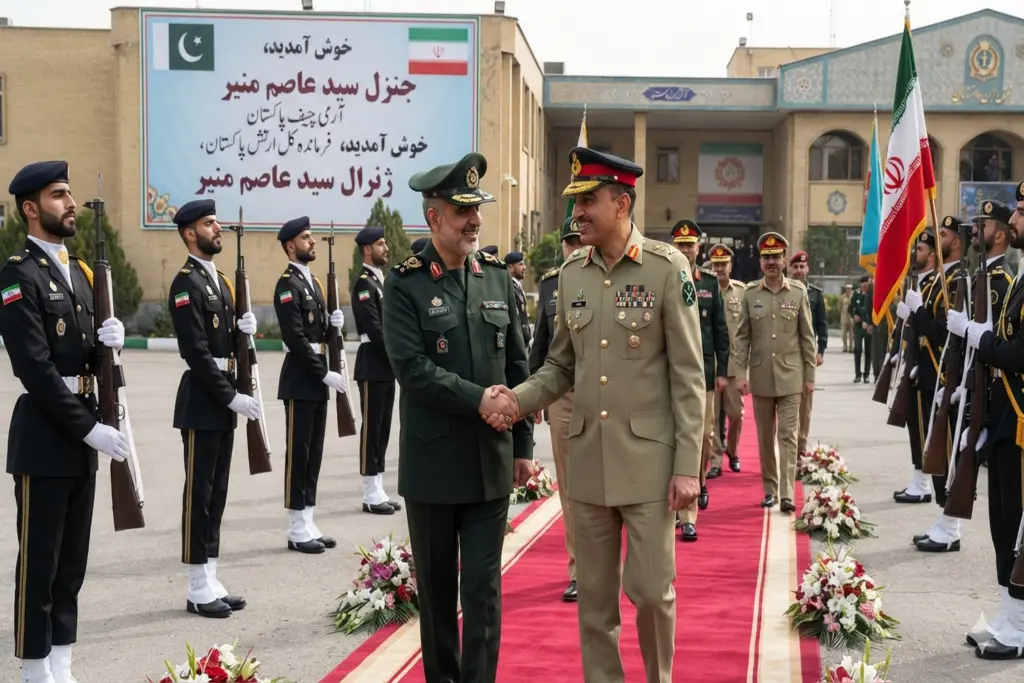
Pakistan’s army chief and chief of defense forces, Field Marshal Syed Asim Munir, will visit Iran next week in a crucial diplomatic event that will help defuse geopolitical tensions in Western Asia and work on security matters across the border. This is a high-level military and diplomatic mission, and unlike other similar visits, it is all about restarting the stalled indirect peace talks and revival of backchannel diplomacy between Washington and Tehran, under the leadership of the Federal Interior Minister Mohsin Naqvi.
The planned visit comes after confirmation from both the Inter-Services Public Relations (ISPR) and Iranian Foreign Ministry Spokesperson Esmaeil Baghaei, which makes Islamabad a key neutral player in resolving the current security standoff in the Middle East.
Restoring the Structural Foundation of the Islamabad MoU
Field Marshal Asim Munir’s Tehran visit’s main goal is to save the fragile Islamabad Memorandum of Understanding (MoU). This successful working agreement was facilitated earlier this year by Pakistani defense and diplomatic teams, presenting a viable plan to de-escalate indirect U.S.-Iran relations. But the peace process took a major hit after recent military attacks and a military response on a number of regional borders.
The next diplomatic meeting will focus on several key operational issues:
Reducing the Trust Deficit: Finding proven ways to reduce the dangers of unintended escalation between Washington and Tehran.
Strategies for dealing with Retaliatory Sanctions: An evaluation of the economic sanctions which were re-imposed in the wake of U.S. President Donald Trump’s new foreign policy rules.
Global Maritime Corridors: Protect maritime security throughout Strait of Hormuz and Red Sea to shield international trade supply chains from asymmetric warfare.
High-Level Diplomatic Coordination Preceding the Tehran Mission
Pre-finalizing the parameters of the Tehran mission, Field Marshal Munir engaged in a long telephonic discussion with U.S. President Mr. Donald Trump at a high level, according to international diplomatic sources. This alignment helped Islamabad to get straightforward and verifiable security parameters and possible de-escalation proposals from Washington.
With these strategic perceptions, the Pakistani delegation will meet with Iranian President Masoud Pezeshkian and top military commanders of Islamic Revolutionary Guard Corps (IRGC) to draw a viable way towards stability in the region. This model for mediation is constructive and multi-layered, which has been embraced by security analysts around the world as well as by Pakistan’s neighbours.
Regional Alliances and Managing Proxies in the Maritime Zone
The meeting will be a discussion on the broader regional security landscape, in addition to direct dialogue between the United States and Iran. The talks come as a result of shifting alliances, such as the recently signed trilateral defence pact between Pakistan, Saudi Arabia and Türkiye.
The Pakistani delegation will discuss issues concerning shipping security, including how to restore stability in the supply routes, which have been disrupted by proxy operations in the Red Sea. Pakistan’s resolve is very strong that the economic development across the border should be ensured by respecting sovereign boundaries and unrestricted movement of trade.