



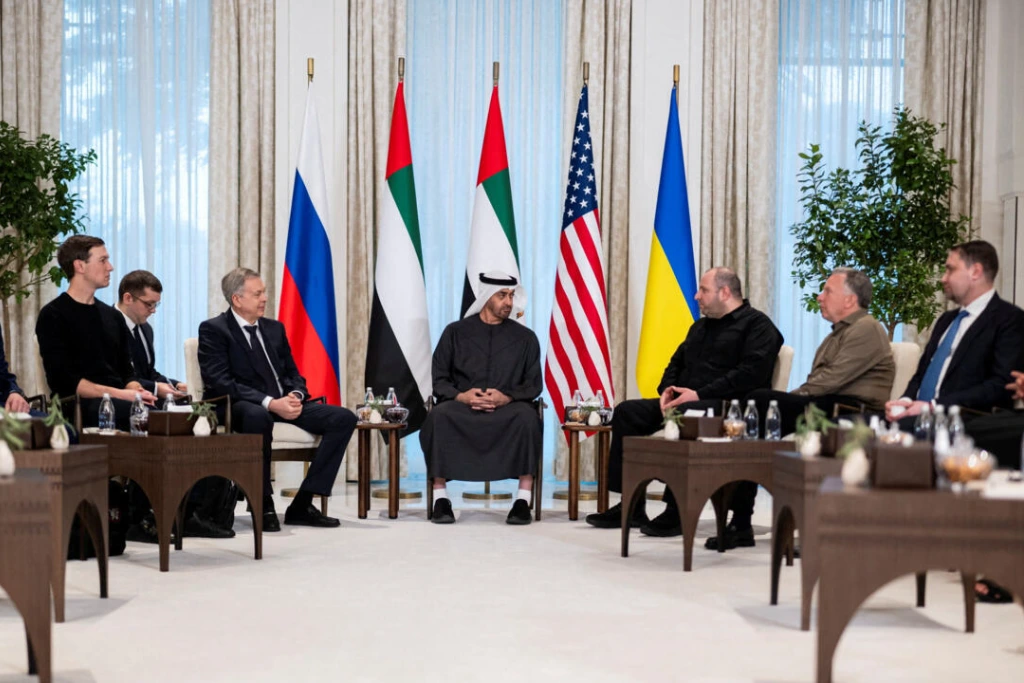
The announcement of a fresh round of trilateral Abu Dhabi peace talks between Russia and Ukraine that will meet in Abu Dhabi on November 10 has rattled the capitals of Europe. The summit is a diplomatic milestone at an important moment in the fight over the continent, and is being facilitated by the United States. With a harsh winter just around the corner, the need to establish a de-escalation process has grown to a fever pitch. The quick diplomatic success, however, conceals a much more intractable fissure between Washington’s short-term electoral goals and long-term plans for security in Europe.
The peace talks in Abu Dhabi are a pivotal moment for Europe, not only because they could provide a way out of this terrible conflict, but because the framework of the negotiations shows a troubling lack of Europe’s influence on its own doorstep.
The Rush for a Pre-Winter Framework
The driving force behind the upcoming talks in the United Arab Emirates is the unforgiving reality of the seasonal clock. Military analysts and humanitarian organizations have repeatedly warned that the upcoming winter could prove to be the most grueling phase of the conflict since its inception. With Ukraine’s energy infrastructure severely strained by years of targeted strikes, the human cost of a prolonged stalemate through freezing temperatures is an existential threat to domestic stability.
For the United States, the motivation to halt the conflict is equally pressing, though driven by a different kind of survival. Following the dramatic “Blue Wave” sweep in the recent US Midterm Elections, the current administration faces intense domestic pressure to demonstrate concrete foreign policy achievements. The American electorate has shown deep fatigue over foreign interventions, and Washington envoys are under strict directives to secure a visible diplomatic victory before the newly elected Congress takes power in January.
This convergence of humanitarian urgency and American political necessity has accelerated the diplomatic timeline. The rush to patch together a pre-winter ceasefire framework is being pushed aggressively by Washington, which views the neutral ground of Abu Dhabi as the ideal venue to force both Moscow and Kyiv into structural concessions.
The Exclusion of European Leadership
While the prospect of peace is universally welcomed, the methodology of the Abu Dhabi summit has triggered severe alarm across Brussels, Paris, and Berlin. European defense leaders have expressed sharp pushback over the fact that the continent’s most significant security crisis since the Second World War is being negotiated primarily by external powers. The trilateral format—dominated by US mediation—leaves the European Union largely on the sidelines of a decision that will dictate its geopolitical future for decades.
This exclusion is a bitter pill for European leaders who have collectively absorbed the heaviest economic shocks of the war, managed massive refugee flows, and dedicated billions of Euros in military and financial aid to sustain Ukraine’s defense. By allowing Washington and Moscow to take center stage in the Middle East, Europe risks accepting a security settlement that prioritizes short-term American political timelines over the structural realities of European border integrity.
European diplomats are rightly arguing that any durable peace agreement cannot simply be a transactional border adjustment dictated from afar. It must involve robust security guarantees, long-term reconstruction frameworks, and an integrated energy strategy—none of which can be successfully executed without Europe holding a direct seat at the negotiating table.
The Risk of a Fragile Peace
The worst that can happen in the Abu Dhabi framework is that the peace will be short-lived and haste-caught, with all the root causes of the conflict not dealt with. Nothing will change if the United States implements a superficial ceasefire in order to appease its own domestic political needs and to freeze the situation in place prior to winter.A ceasefire that is only short-term in order to meet domestic political demands will be a sham. Such a frozen conflict with no deep structural guarantees would simply give competing sides the chance to rearm, reconvene, and wait for a better geopolitical moment to start a “new round of fighting”.
Mistaken peace is worse in Europe than a carefully worked out peace. It would render the continent permanently in a state of high alert, generating vast defense spending, economic anxiety and inaction towards a durable stability on its eastern border.
As November 10 approaches, the eyes of the world will be on Abu Dhabi. The top is a deep crossroad. If European countries can succeed in asserting themselves and make the discussions a holistic, multi-lateral process, it could signal the beginning of a secure and sovereign European order. But the rush to settle before the winter will likely leave the Abu Dhabi peace talks as a shallow transaction that avoids European consensus, and the loss of European control over its own geopolitical destiny.