



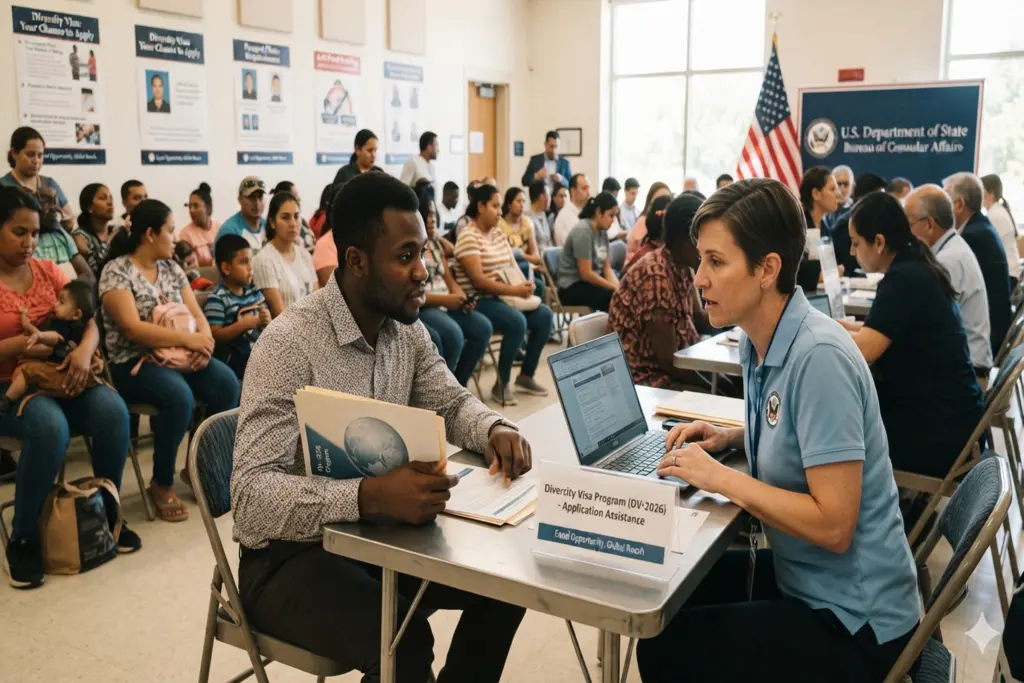
In a major development for international migration channels and thousands of global lottery selectees, the United States Department of State has officially resumed the processing and issuance of Diversity Visas. The automated structural restart follows a high-profile federal court injunction that overturned a previous administrative freeze implemented to review security vetting protocols and public-charge metrics.
The strategic policy update follows the legal ruling in the federal lawsuit Medani versus Trump presided over by Judge Edward J. Davila of the U.S. District Court for the Northern District of California. The court ruled that the sweeping suspension of immigrant visa programs strayed from standard statutory provisions, commanding consular desks to instantly reactivate database clearings and interview tracks globally.
Racing the Absolute September 30 Statutory Deadline
While the resumption brings immense relief to lottery winners, candidates and consular managers are locked in a high-stakes race against time. Under strict United States immigration law, the statutory authority for the DV-2026 lottery program expires completely at midnight on September 30, 2026.
The regulatory operational window enforces three critical processing boundaries:
Irreversible Quota Forfeiture: Any selectee who fails to secure an officially issued immigrant visa number before the close of the fiscal year on September 30 will permanently lose their allocation, as courts lack the statutory authority to extend the deadline.
Consular Interview Backlogs: Embassies and consulates are expanding shift capacities to accommodate sudden data vetting queues and process stranded biometric records.
Adjustment of Status Reactivation: Selectees currently residing within the United States on temporary non-immigrant visas can immediately request U.S. Citizenship and Immigration Services to lift processing holds and resume local adjustments.
Enhanced Security Vetting and Public Charge Compliance Audits
Although the federal court order successfully eliminated the blanket administrative lockout, homeland security screening matrices remain exceptionally rigorous. The Department of State verified that all applicants must pass through extensive software-backed background checks to confirm public safety compliance.
Consular officers are evaluating applicants across two primary security baselines:
Biometric and Inter-Agency Scanning: Cross-referencing facial recognition data and fingerprint logs against international law enforcement databases to isolate potential security risks.
Public Charge Financial Verification: Confirming that applicants possess sufficient financial backing or a verified U.S. sponsor to ensure they will not require state welfare support upon arrival.
Capped Fiscal Allocations for the DV Program
While the statutory maximum for the Diversity Visa program is traditionally set at 55,000 visas per year, the numerical ceiling for the current cycle is tightly capped at approximately 51,850 visas. This reduction follows deductions mandated under the Nicaraguan Adjustment and Central American Relief Act regulations, significantly sharpening the competition index.
Lottery winners across key regions, including South Asia and Central Asia, are advised by legal immigration consultants to monitor their case status portals around the clock. Applicants should ensure all medical reviews, local police clearances, and certified civil documents are filed with consular tracking desks immediately to secure final visa stamps before the fast-approaching fiscal deadline.




1 Comment
Pingback: New Zealand Overseas Job Payment Ban 2026 | Pakistan Truth