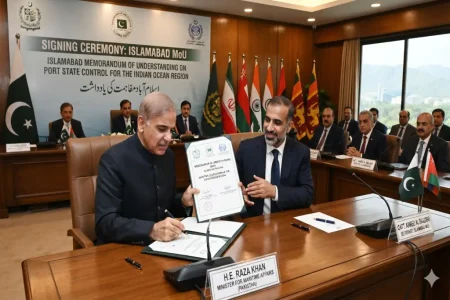



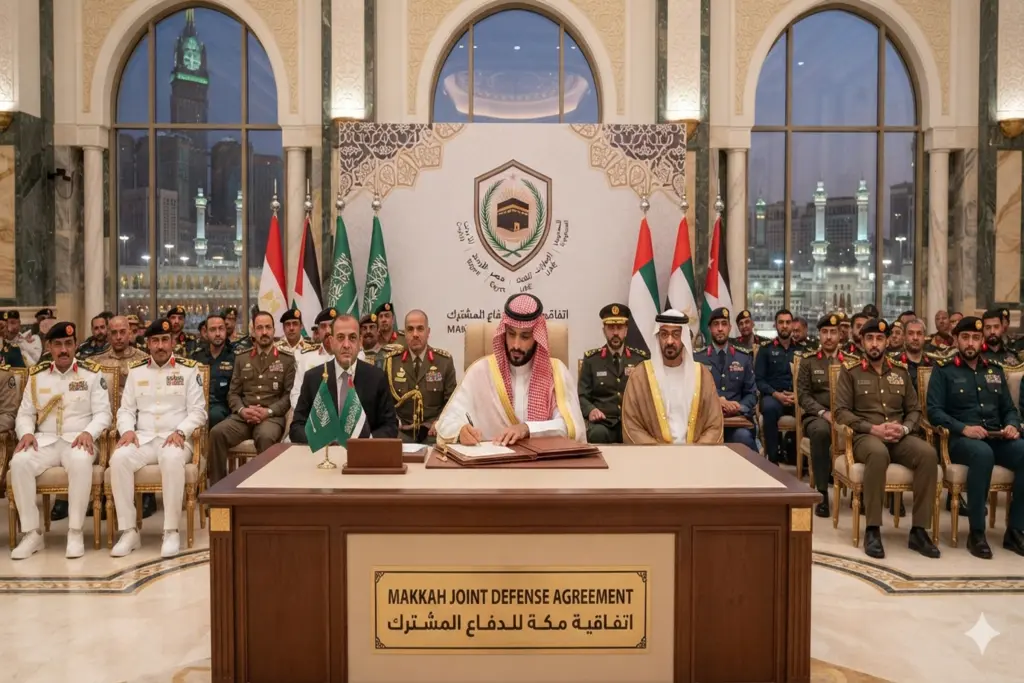
Saudi Arabia, Turkey and Pakistan have signed a historic trilateral mutual defence pact, dubbed the Makkah Joint Defense Agreement, which brings a new, collective security mechanism to the region. The contents of this “attack on one, attack on all” doctrine for the three most powerful military and economic powers of the Muslim world were signed at the Al-Safa Palace in the holy city of Mecca—a document which is considered one of the most important in history.
Said to be signed by Saudi Crown Prince Mohammed bin Salman, Turkish President Recep Tayyip Erdogan, and Pakistani Prime Minister Shehbaz Sharif, along with top military brass, including Army Chief Field Marshal Asim Munir. The agreement does not intend to create an offensive axis, but rather to reinforce collective deterrence in the face of heightened instability in the region.
Geopolitical Drivers and the Decline of the Western Security Umbrella
The Makkah Agreement stems directly from a rapidly evolving and dynamic security context in the Middle East. Gulf countries have been heavily dependent on the United States as their chief security guarantor for decades. But recent geopolitical changes, especially the direct military consequences of the U.S.-Israel conflict with Iran, have made this arrangement a difficult one to maintain.
As strategic energy routes in the Red Sea and the Strait of Hormuz were severely affected and infrastructure was threatened via proxy, the Saudi capital saw the value of a one-sided defense umbrella under the West as being restricted. Saudi Arabia is reaching out to the Muslim world, aiming to establish a self-reliant strategic framework by diversifying its partnerships. This move is a result of a new multipolar world in which regional powers seek strategic autonomy instead of relying on outside forces.
The Convergence of Power: Financial, Technological, and Nuclear Capabilities
The real significance of this alliance is that each signatory has complementary and different strengths to offer:
Saudi Arabia (Financial Capital & Maritime Power): As one of the world’s biggest oil exporters, the city of Riyadh also holds the vast economic power to fund massive defense integration and maritime security missions, as well as being the custodian of the holiest sites of Islam.
Turkey (Advanced Defense Industry & Combat Experience): Ankara is the second largest active military power in NATO, with elite military technology. The energy sector is a strong potential market for joint military manufacturing with the metering capabilities of advanced drones, naval warships, and aerospace programs that are renowned in Turkey.
As the only nuclear armed Muslim state, Pakistan adds a great implied strategic value, rocket power, and an extremely battle hardened military. Pakistan already has some 8,000 troops, air defense systems and fighter jets deployed within the Kingdom to bolster Saudi Arabian borders.
The people of #Pakistan welcome Makkah Joint Defence Agreement – A historic milestone towards peace, security and stability@CMShehbaz @PakPMO @ForeignOfficePk @PakinSaudiArab @PakinTurkiye @KSAMOFA @trpresidency @RTErdogan @KSAembassyPK #RadioPakistan #news pic.twitter.com/OVWUo0pTev
— Radio Pakistan (@RadioPakistan) August 9, 2026
Scope of the Agreement and Operational Reality
The public aspect of the agreement is that it is a mutual defense agreement against armed attacks, but defense analysts note that it has more of a political and strategic overtones than a ready-to-go combined military force. The text includes provisions for extensive integration in multiple key areas:
Intelligence sharing & Joint Drills: Enhancing real time intelligence sharing and broadening trilateral military drills in the land, air and sea areas.
Technology Transfer & Joint Production: Joint production arrangements in which Turkish technology can be utilized to produce the hardware in Saudi Arabia and Pakistan. Particularly, Turkey is eager to incorporate both allies in its program of 5th generation fighters.
Maritime Security: Building coalitions to ensure the security of shipping lanes in the Red Sea and the Gulf of Aden from non-state actors.
Notably, Saudi and Turkish governments have made efforts to defuse possible short-term diplomatic fallout by explicitly stating that the pact is not directed at any particular country. Turkish Foreign Minister Hakan Fidan said that the treaty contains no provision of common threat and suggested it may be expanded “Egypt is a natural next step, I believe, to join this defensive umbrella”.
Global Impact and Potential Challenges
The signing of the Makkah agreement has been heard around the world. In Tehran, the reaction has been negative and Iranian authorities are openly skeptical about this pact’s capacity to secure long-lasting security in the Gulf. Meanwhile, normal regional powers such as India have observed how their balance of power in South Asia and the Middle East has been changing, and are watching with caution.
The key to the success of the treaty will be its implementation on the ground. It is a treaty that not only connects three countries but brings three different foreign policies under one umbrella, and in which it will be important to manage expectations carefully without escalating tensions in the region. Despite these limitations, the Makkah Joint Defense Agreement is an important milestone in modern international relations and represents an important step in regional powers shaping the future of Middle East stability and peace.