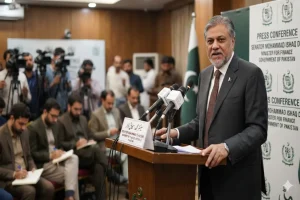



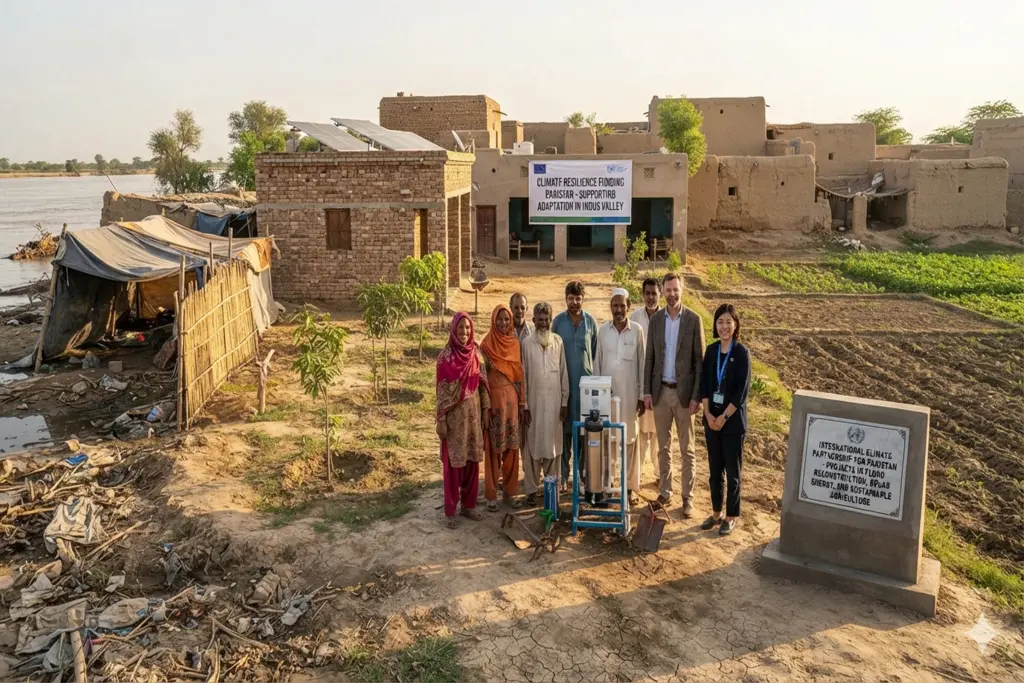
In a major geostrategic advancement for international environmental compliance, corporate financial alignment, and macro-prudential asset protection, Federal Minister for Finance and Revenue Muhammad Aurangzeb has called for immediate climate funding for Pakistan.
The urgent economic appeal, delivered before an elite gathering of international financial managers, World Bank executives, and IMF controllers on the sidelines of the UN General Assembly sessions, transitions traditional credit structures into a data-driven climate resilience sandbox. Addressing the deep-seated structural vulnerabilities generated by shifting weather patterns, the Finance Minister utilized an empirical, certified audit manual to establish that although Pakistan’s manufacturing centers contribute less than one percent to global carbon output, its sovereign currency reserves, agricultural trade lines, and infrastructure grids bear an unsustainable financial burden from climate disasters.
Eliminating the Debt Loop Through Automated Green Grants and Cashless Capital Assets
The Finance Ministry’s system-vetted presentation bypassed legacy manual documentation to map out the severe transaction friction inflicted upon the domestic economy by consecutive flash floods and glacial breaches. The calculated policy brief establishes three primary structural recovery tracks:
The Sovereign Grant Intervention: Moving away from standard manual borrowing protocols that expand the sovereign debt trap, the minister demanded the activation of automated, interest-free climate grants and equity-free sub-sector funding from global green facilities.
Frictionless Capital Upgrades: Launching digital vetting platforms linked with FBR and NADRA cloud pipelines to manage verified Green Bonds (Eco-friendly investment certificates) that systematically attract international foreign direct investment into carbon-neutral infrastructures.
Protecting the Domestic Budget Index: Insulating state development funds from being continuously diverted into manual disaster response actions, allowing the federal cabinet to safely lock its liquidity buffers into long-term health, education, and human development portfolios.
Enforcing Machine-Readable Accountability Across Environmental Sub-Sector Funds
To build maximum predictability and absolute trust across international banking networks, Minister Muhammad Aurangzeb verified that the state has completely converted its internal resource-allocation monitoring into a 100% paperless, software-backed repository. Global compliance officers can securely track all incoming international climate funds via an automated system dashboard that deploys computerized geolocation tracking and multi-spectral digital logs to eliminate manual leakages or black marketing channels.
By prioritizing transparent technological pipelines and routing clean energy initiatives through the Special Investment Facilitation Council (SIFC), Pakistan establishes a resilient blueprint for sustained, eco-friendly macroeconomic growth, upgrading its soft image on the international economic landscape.