



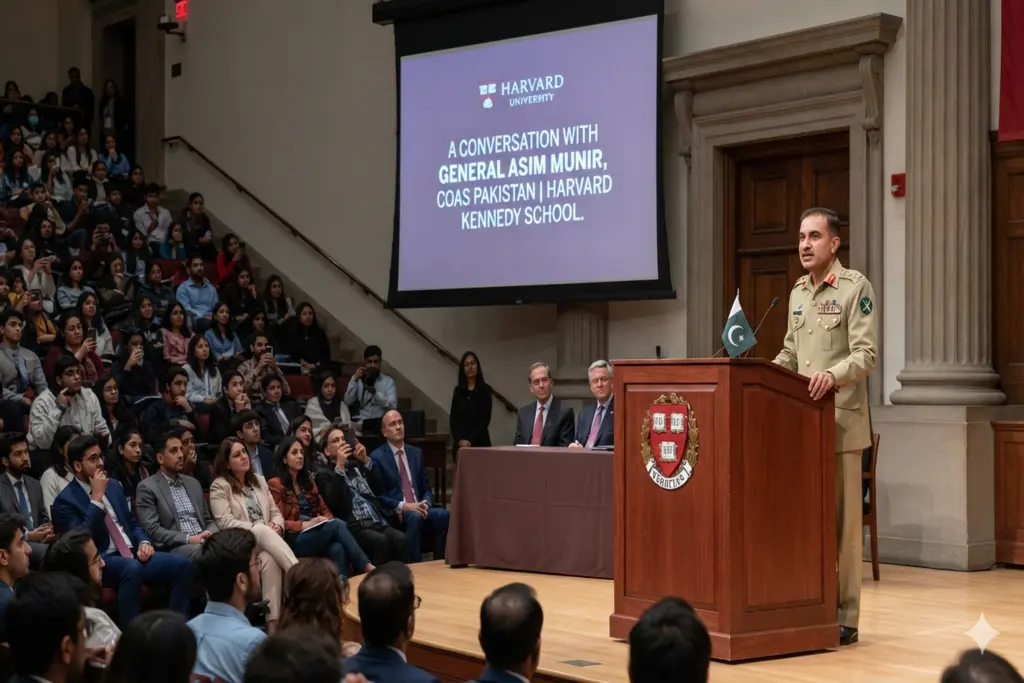
In a significant move to foster international academic diplomacy and project Pakistan’s structural geopolitical outlook onto the global stage, Chief of Army Staff and Chief of Defense Forces Field Marshal Syed Asim Munir hosted a high-level multinational delegation of students from Harvard Business School.
The extensive intellectual convention, held at the General Headquarters (GHQ) in Rawalpindi, focused closely on analyzing shifting regional and global dynamics, Pakistan’s sovereign security architecture, and the state’s calculated efforts to catalyze long-term peace, financial stability, and shared prosperity across the region and beyond.
Combating Asymmetric Propaganda Through Fact-Based Analytics
During the interactive session, Field Marshal Syed Asim Munir delivered a critical philosophical and structural brief to the international scholars regarding modern warfare paradigms [HBS]. He emphasized that the contemporary global ecosystem has grown increasingly volatile, fragmented, and vulnerable to digitized hybrid campaigns, fake news vectors, and coordinated social media propaganda.
To build a resilient human capital framework capable of navigating these structural disruptions, the Field Marshal highlighted several key operational pillars for the young workforce:
Application of Fact-Based Analytics: Shifting away from emotional consumption patterns toward data-driven verification models and rigorous fact-based analytics to systematically counter structural misinformation.
Empowering Through Skill Development: Upgrading traditional academic paths toward high-value technical skill development, software engineering, and corporate data literacy.
Global Tech Entrepreneurship: Encouraging young minds to move from being passive tech consumers to active builders of global startups, digital financial infrastructure, and scalable businesses.
Chief of Army Staff and Chief of Defence Forces Field Marshal Syed Asim Munir has interacted with a delegation of students from #HarvardBusinessSchool, representing multiple countries, during their visit to #Pakistan@OfficialDGISPR @HarvardHBS #RadioPakistan #News… pic.twitter.com/LkNEmUq8NS
— Radio Pakistan (@RadioPakistan) August 28, 2026
Harvard Scholars Commend Pakistan’s Latent Commercial Sectors
The international students from Harvard Business School shared their direct, first-hand experiences accumulated during their ongoing stay in Pakistan. The delegates expressed profound appreciation for the visible openness, hospitality, and warmth exhibited by the citizens of Pakistan, noting that the country’s localized ground realities stand in stark contrast to obsolete, negative international media narratives.
The corporate management scholars highlighted that Pakistan possesses tremendous economic potential and expansive investment opportunities across various sectors. The delegation noted that the state’s emerging tech hubs—including recent cloud data center rollouts and synchronized agro-industrial frameworks like the National Olive Chain Policy—position the country as a highly resilient emerging economy with competitive young human capital.
Reaffirming the State’s Macroprudential Mandate for Regional Safety
The strategic brief also contextualized Pakistan’s broader foreign policy positions, including its recent high-profile mediation channels between Washington and Tehran to maintain trade lane security in the maritime zone. Field Marshal Asim Munir reaffirmed that Pakistan remains a cornerstone of regional security, leveraging its trilateral partnerships—including defense and industrial pacts with Saudi Arabia and Türkiye—to defend state sovereignty while preserving collaborative trade blocks.