




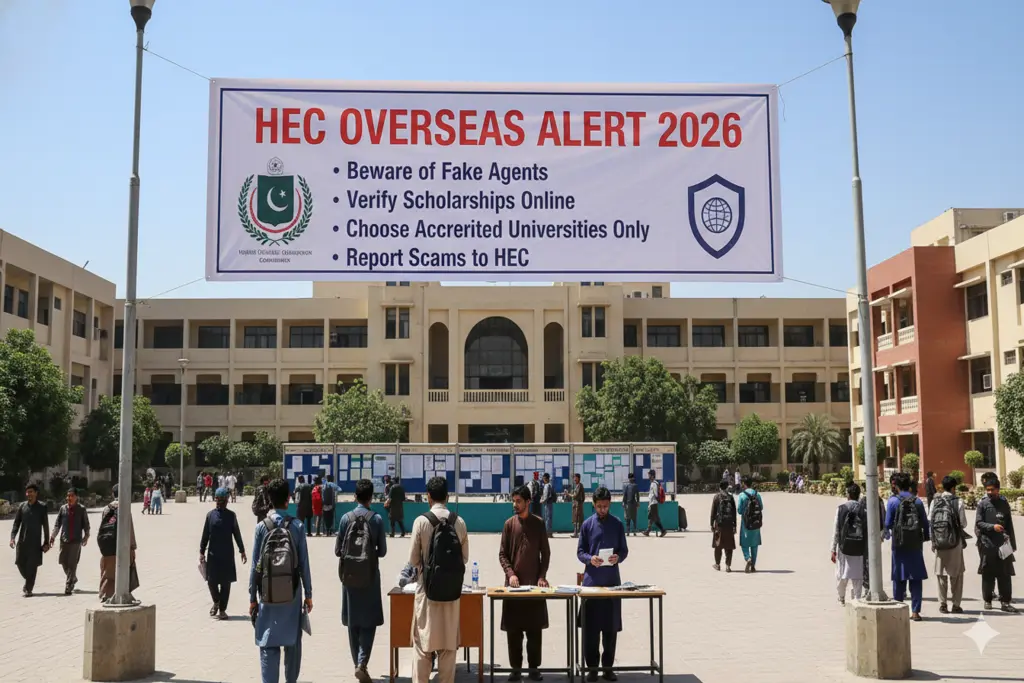
Higher Education Commission (HEC) of Pakistan has issued an Emergency Public Advisory document containing stringent structural changes to the system related to International qualification verification. The new guidelines have been implemented with a zero-tolerance approach towards unrecognized remote setups, cross-border education loopholes and misleading structures set up online by students. To achieve local recognition, complete alignment to these modernised evaluation benchmarks is essential for someone who is either an overseas Pakistani or a local student studying towards a qualification from an external institution.
Core Changes Under the 2026 Guidelines
The updated framework resolves several of the that have been created by the old assessment framework, including a clear standardisation of the ways secondary, non-traditional (and academic) formats are assessed. Major structural requirements are:
Mandatory Physical Residency: If the applicant cannot demonstrate that they have physically practiced within the host country for the full period of the program in line with the qualifications, all such qualifications will be rejected at once. During evaluation, passport exit-entry stamps and travel history is cross-checked.
Equivalence for Distance and Blended Formats: Degrees obtained through distance or blended (online and face-to-face) learning are equivalent only if these forms of learning are specifically recognized, licensed and accredited by the government regulatory authority of the country where the diploma is awarded.
Transnational Education (TNE) Enforcement: If the parallel, unapproved pathway is offered by a domestic institute holding a partnership arrangement with an international university, it is immediately suspended from receiving any new No-Objection Certificates (NOC).
Step-by-Step Online Verification Process
To accelerate processing speeds, HEC has completely retired legacy manual paper collection channels. Applicants must utilize the centralized electronic framework to submit copy-only digital dossiers:
- Account Provisioning: Create a secure biometric-verified profile on the official HEC e-Services Portal using your Computerized National Identity Card (CNIC) or National Identity Card for Overseas Pakistanis (NICOP).
- Dossier Upload: Digitally upload your entire educational history sequentially, starting from Bachelor’s programs up to Doctoral degrees. For foreign secondary or higher secondary schooling, attaching a valid Inter Board Coordination Commission (IBCC) equivalence certificate is a mandatory prerequisite.
- Direct Institutional Verification (Genuineness): In compliance with global data privacy frameworks, applicants must instruct their awarding foreign university to dispatch a direct confirmation of degree legitimacy. This verification must be sent via an official institutional domain email directly to HEC’s dedicated international appraisal mailbox or sent as a sealed, stamped courier parcel.
- Electronic Fee Settlement: Once the portal processes your preliminary entry, it generates a unique consumer invoice. Pay the designated processing fee (Rs. 5,000 per degree evaluation) using the 1-Link electronic network via mobile banking applications, web banking portals, or any ATM terminal.
Verifying University & Program Legitimacy Before Enrolling
To mitigate the risk of falling prey to substandard online operations, degrees must be issued by legally recognized global entities. Students are required to verify credentials using any of these verification tools:
Prior to finalizing your admission, you should check the World Higher Education Database (WHED) to verify that the institution you are considering has a recognized, active status in its National ministry in the country where it is located, or agency for quality assurance.
In technical or regulated professions e.g. engineering, medicine, law etc., the foreign program must meet the qualification requirements laid out by specific professional councils in Pakistan (e.g. PEC, PMDC or PBC).
Failure to follow these rules on foreign degree equivalence is essential to protect the professional line of succession, and to ensure qualification for valid recognition in the local job market and civil services.