


With historic inflation eroding the purchasing power of cash sitting in conventional savings accounts, retail savers are hunting for a bulletproof financial haven. Traditional commercial bank deposits often underperform when weighed against fluctuating market rates and steep management overheads. Fortunately, Government of Pakistan Treasury Bills (T-Bills) have emerged as the absolute safest, high-yield investment instrument available. Historically restricted to institutions investing millions, recent digital regulatory updates by the State Bank of Pakistan (SBP) have completely democratized this space.
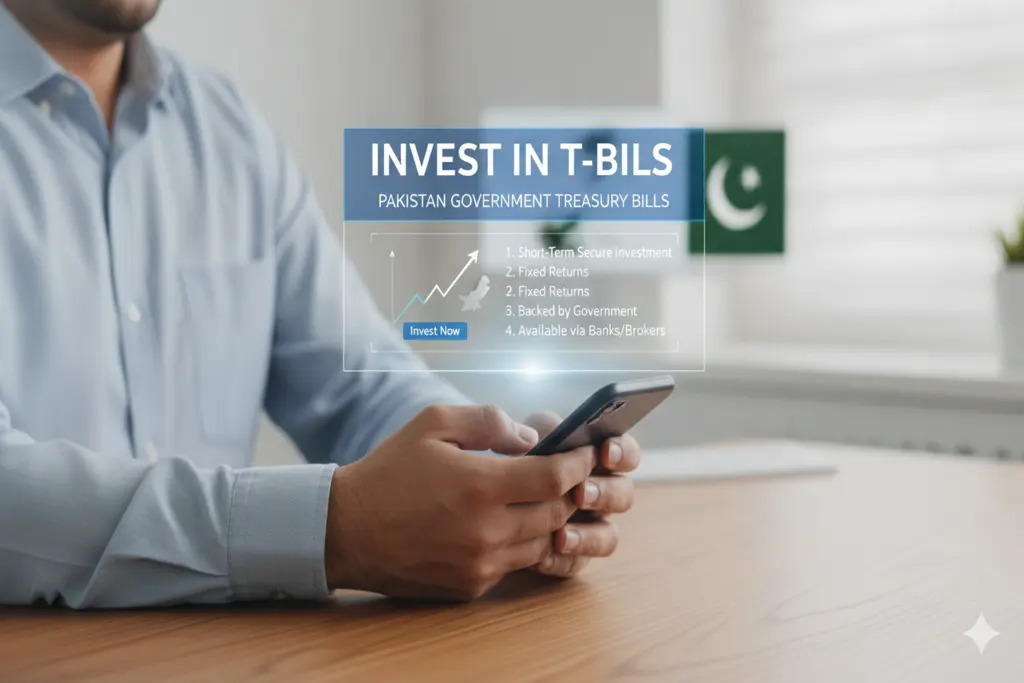
Today, everyday citizens, micro-savers, and university students can seamlessly Invest in T-Bills in Pakistan from their mobile phones with a minimum capital of just Rs. 5,000. This step-by-step operational guide outlines how T-Bills function, how to deploy your funds via a smartphone app, and how to maximize your risk-free returns.
1. What are Treasury Bills and Why are They 100% Risk-Free?
Treasury Bills, commonly referred to as T-Bills, are short-term sovereign debt instruments issued directly by the Government of Pakistan through the central bank to fund public fiscal expenditures.
Sovereign Guarantee: Because these securities are backed directly by the state, they carry zero default risk. Your principal amount is entirely secure, making it a safer option than corporate bonds or equity trading.
Investment Tenures: T-Bills are auctioned at flexible, short-term maturity brackets: 3 Months, 6 Months, and 12 Months.
The Discounted Rate Model: T-Bills do not pay regular monthly coupons. Instead, they are sold at a discount to their face value. For example, if you purchase an Rs. 5,000 face-value T-Bill, the platform will only deduct around Rs. 4,250 (depending on active yields) from your digital wallet. Upon maturity, the government pays you the full Rs. 5,000 face value. The mathematical difference represents your upfront, net profit.
2. Step-by-Step Guide to Buy T-Bills on Your Phone
In the past, individual investors had to endure manual, complicated paperwork at specialized commercial bank branches to set up an Investor Portfolio Securities (IPS) account. Today, major retail fintech platforms and commercial banking apps allow you to launch your asset profile within minutes.
Step 1: Install a Registered Fintech App and Verify Your Profile
Download a licensed digital brokerage or investment app (such as KTrade, Finox, or your bank’s specialized investment portal). Navigate to the “Government Securities” onboarding window. Upload a photo of your Computerized National Identity Card (CNIC) and complete the digital biometric verification to instantly activate your micro-IPS or Sahulat account.
Step 2: Fund Your App Wallet
Once approved, transfer your investing capital (a minimum of Rs. 5,000) into your trading account wallet. You can utilize standard Interbank Funds Transfer (IBFT), corporate banking applications, EasyPaisa, or JazzCash to fund your balance smoothly.
Step 3: Select Your Preferred Maturity Bracket
Open the “Fixed Income” or “Government Securities” dashboard within the app. Here, you will see a real-time list of upcoming 3-month, 6-month, and 12-month T-Bills, along with their annualized indicative yields (annual profit rates).
Step 4: Input Capital and Execute Your Bidding Order
Select your preferred maturity timeline, enter your desired investment amount (multiples of Rs. 5,000), and tap “Invest”. Your digital platform will automatically pool your funds into the next primary SBP auction, assigning the government certificates directly to your electronic account.
3. Taxation and Advanced Portfolio Management
When choosing to Invest in T-Bills in Pakistan, understanding the taxation rules will help you accurately calculate your net take-home returns:
Filer vs. Non-Filer Tax Rates: Profit derived from government securities is subject to withholding tax at source. Active tax filers enjoy a reduced tax rate (typically around 15%), whereas non-filers face a much steeper penalty rate of up to 30%. Becoming a registered tax filer is highly recommended to protect your profit margins.
Zakat Exemptions: Government T-Bills are exempted from compulsory automated Zakat deductions at the bank level, giving you full control over your charitable allocations.
Secondary Market Liquidity: If an unexpected financial emergency arises before your maturity tenure ends (e.g., 2 months into a 6-month bill), you do not have to wait. You can instantly sell your active T-Bills back into the secondary market via your mobile app dashboard to liquidate your holdings into cash.
Sovereign-backed wealth creation is no longer gatekept by elite financial institutions. By utilizing smartphone-based investment portals, any individual in Pakistan can start compounding small sums of money securely under state guarantees.