




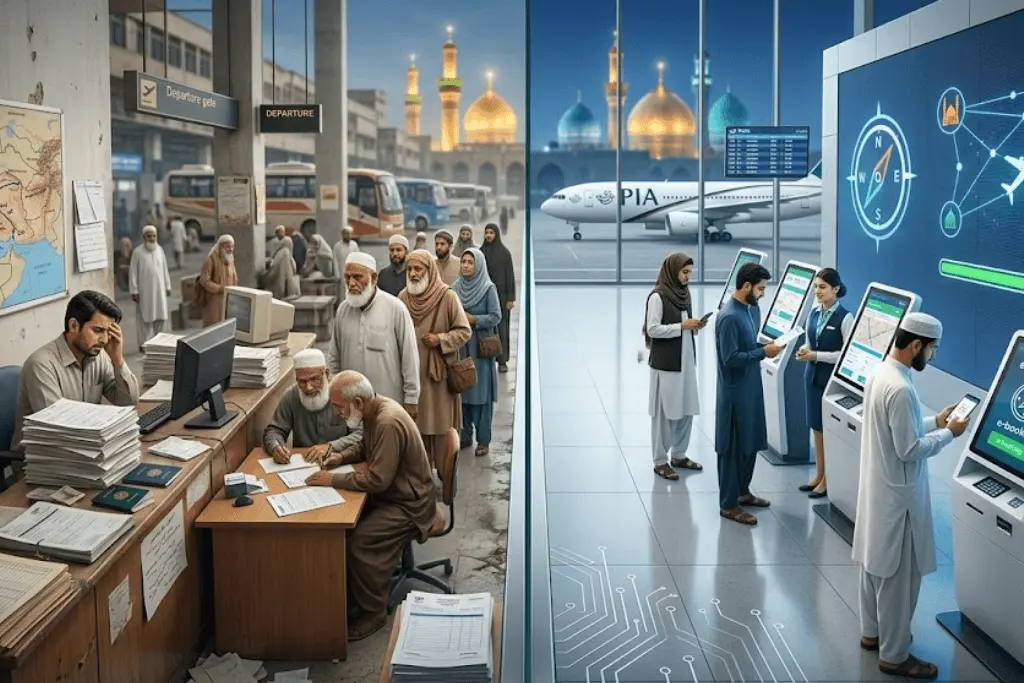
The Ministry of Religious Affairs and Interfaith Harmony, in close coordination with the Federal Government, has officially launched the Iran & Iraq Pilgrims New Booking System, a highly regulated online platform for Pakistani pilgrims travelling abroad to visit religious sites located in Iran and Iraq. This structural shift fully implements the newly approved Ziyarat Management Policy, creating a centralized digital framework. The new process aims to safeguard travelers, eliminate financial fraud by unauthorized travel agents, and streamline immigration data at international exit points.
In this new directive, the informal travel system is totally eradicated after 20 years. Every prospective pilgrim is now required to be registered and make his way through the system of registration under the control of the state. This is a detailed article about the basic updates of its functioning, new visa charges, and detailed instructions on how to make a safe booking for your holy pilgrimage.
The Shift from the Salar System to Ziyarat Group Organizers (ZGOs)
The most significant structural reform under the new process is the permanent abolition of the traditional “Salar” system. Under the previous system, private group leaders managed caravan travel with minimal state oversight, leading to documented issues with accommodation quality, tracking, and visa overstays.
The new structure includes the following changes:
Mandatory Group Travel: Single pilgrimage visas are not issued except under special circumstances. All pilgrims are required to come in a group and be connected to a verified data stream.
Only Ziyarat Group Organizers (ZGOs) licensed by the government can be hired by pilgrims for their trip. The ministry has approved and registered 262 operators to provide all transport, accommodation and logistics in Pakistan.
Legal Accountability: Every licensed ZGO is legally accountable for bringing in, keeping safe and repatriating each and every pilgrim who registers under their ZGO ID. Any companies who aid and abet in illegal travel will be immediately shut down and prosecuted.
Strict Visa Penalties and Passport Rules
To prevent illegal immigration and safeguard Pakistan’s diplomatic standing, the host nations of Iran and Iraq have updated their entry and residency laws in coordination with Pakistani authorities:
Passport Retention: Upon arrival at Iraqi border checkpoints, pilgrims’ physical passports will be safely retained by Iraqi border immigration for the duration of their stay. Passports are handed back to the group leader only upon departure.
Visa Validity Limits: Pilgrimage visas are strictly single-entry and valid for a maximum duration of 30 days. These visas cannot be extended or repurposed under any circumstances.
Overstay Fines: Iraqi authorities enforce a strict fine of $385 (approximately Rs. 107,037) for individuals overstaying up to 60 days. Overstaying beyond this window leads directly to immediate arrest, detention, and deportation.
Step-by-Step Online Registration and Booking Process
Intending pilgrims must execute their travel bookings digitally by following this verified workflow:
Verify Your Chosen ZGO: Before making any financial payments, visit the official Ministry of Religious Affairs portal to cross-check and verify that your chosen company is on the approved list of 262 ZGOs.
Submit Biometrics and Credentials: Provide your valid Computerized National Identity Card (CNIC), an original passport with at least 6 months of validity, and updated international health certificates.
Digital Data Integration: The chosen ZGO logs your profile onto the centralized management platform developed by the National Information Technology Board (NITB). This platform securely shares verified pilgrim tracking data with the Federal Investigation Agency (FIA).
Transit Compliance: Travel is routed mainly through the approved air corridors as there are continuing security evaluations of transit routes overland. Flight frequencies have been substantially increased to cater for the huge numbers of pilgrims at busy periods, by the Civil Aviation Authority (CAA).