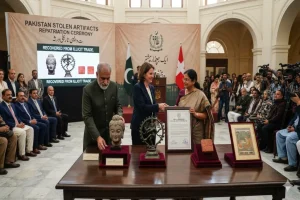


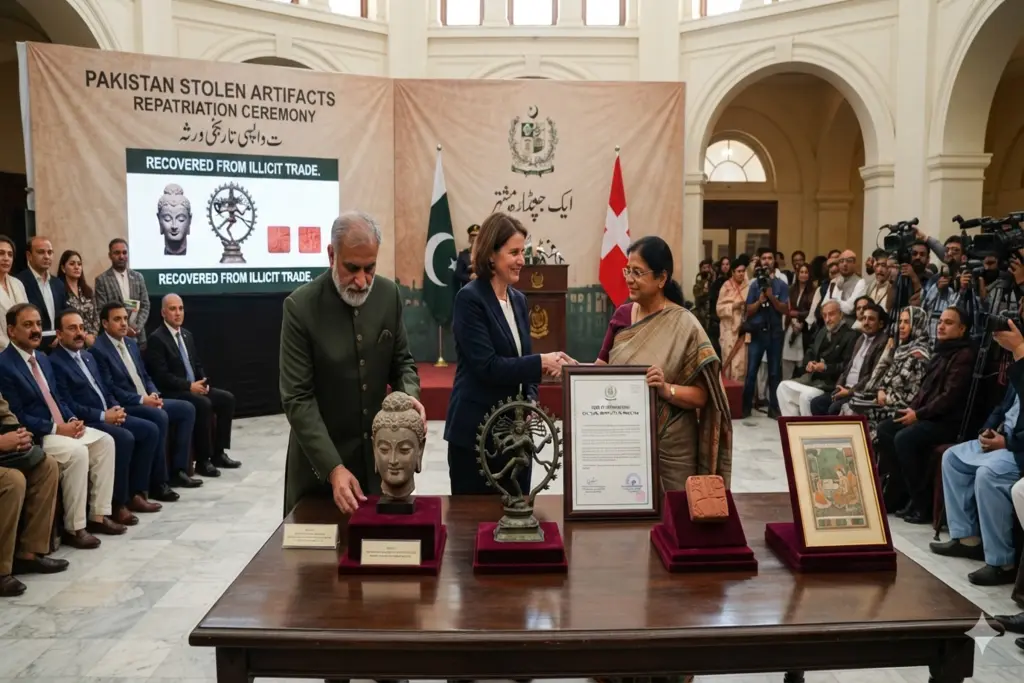
In a major geostrategic advancement focused on cultural property protection, international asset recovery, and the elimination of cross-border smuggling networks, the United States has officially returned 36 stolen historical artifacts to Pakistan.
The formal repatriation ceremony was hosted at the Manhattan District Attorney’s Office in New York, where Pakistan’s Consul General Aamer Ahmed Atozai received the rare collection on behalf of the federal cabinet. The successful recovery operations, engineered by the Antiquities Trafficking Unit alongside US Homeland Security Investigations (HSI), transition traditional border tracking into a high-speed digital surveillance sandbox, successfully reclaiming centuries-old sovereign treasures from illicit global trade loops.
Vetting the Ancient Gandhara Relics and Technical Preservation Metrics
The finalized administrative logs verify that the 36 repatriated antiquities date back to the historic Gandhara period and the ancient Mehrgarh civilization. Looted from archaeological excavation sites over the past several decades using manual documentation loopholes, these precious objects have now been completely extracted from black market distribution channels.
The multi-sectoral recovery portfolio encompasses several critical historical assets:
High-Tier Asset Valuation: Financial compliance auditors and archaeological appraisers estimate the international valuation of these cultural items to run into millions of dollars, representing an invaluable contribution to the country’s national history.
The Sculptural Inventory: The dynamic registry contains sacred Gandharan friezes, stucco Bodhisattva heads, terracotta figurines, and ancient coins linked to illegal smuggling matrices led by disgraced art dealers like Subhash Kapoor.
Digital Cloud Cataloging: The Department of Archaeology and Museums in Islamabad is actively building a secure, paperless cloud database to perform absolute machine-readable scans of every artifact, assigning a permanent biometric-style identity to insulate the country’s heritage assets.
Inter-Agency Collaboration and Museum Relocation Workflows
Assistant District Attorney Matthew Bogdanos commended Pakistan’s rich historical background, affirming that both sovereign states will continuously expand automated information exchange networks to neutralize antiquity trafficking corridors. Consul General Atozai expressed deep gratitude to the US law enforcement managers, verifying that this event marks the fifth major historical transfer executed between the two partner nations.
The state architecture is finalizing secure logistics to safely relocate the collection back to Pakistan, where they will be permanently displayed inside premium federal museums to boost educational tourism, stimulate research sandboxes, and elevate Pakistan’s software image on the global stage.