

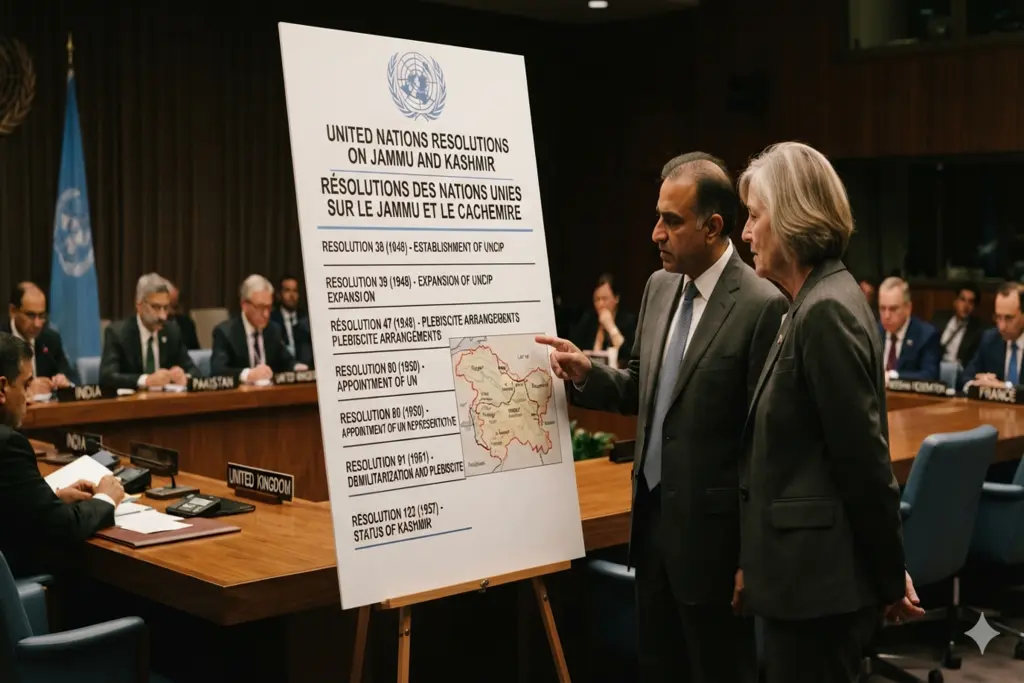
Deputy Prime Minister and Minister for Foreign Affairs Mohammad Ishaq Dar has written to the President of the United Nations Security Council (UNSC) in a formal letter. As a high level diplomatic deal, he said that the resolutions of the UN must be implemented as per the original intent. He explained that the Kashmir issue is not only about “territory” but about the right to self-determination of millions of people, which is recognised by the international community. Pakistan is clear that sustainable peace in South Asia is possible only through the aspirations of the Kashmiri people and UN relevant resolutions.
Severe Human Rights Violations in IIOJK
The Deputy Prime Minister voiced his extreme apprehension over the alarming situation of human rights in Indian Illegally Occupied Jammu and Kashmir (IIOJK). In the letter, it is noted that extrajudicial killings, enforced disappearances, torture, arbitrary arrests and drastic restrictions on peaceful assembly have become commonplace under Indian occupation. Targeting innocent civilians is a regular occurrence under draconian laws which infringe on fundamental human rights and on international laws. The right to freedom of expression has been totally curtailed by the occupation forces in an attempt to quell the voice of the Kashmiri people which is legitimate.
<blockquote class=”twitter-tweet”><p lang=”en” dir=”ltr”>DPM <a href=”https://x.com/MIshaqDar50?ref_src=twsrc%5Etfw”>@MIshaqDar50</a> has called upon <a href=”https://x.com/UN?ref_src=twsrc%5Etfw”>@UN</a> Security Council to implement its resolutions on Jammu and Kashmir<a href=”https://x.com/ForeignOfficePk?ref_src=twsrc%5Etfw”>@ForeignOfficePk</a> <a href=”https://x.com/hashtag/KashmirbaneygaPakistan?src=hash&ref_src=twsrc%5Etfw”>#KashmirbaneygaPakistan</a> <a href=”https://x.com/hashtag/IIOJKundersiege?src=hash&ref_src=twsrc%5Etfw”>#IIOJKundersiege</a> <a href=”https://x.com/hashtag/RadioPakistan?src=hash&ref_src=twsrc%5Etfw”>#RadioPakistan</a> <a href=”https://x.com/hashtag/news?src=hash&ref_src=twsrc%5Etfw”>#news</a> <a href=”https://t.co/mPtwk0wteo”>https://t.co/mPtwk0wteo</a> <a href=”https://t.co/R3VQfqMBCK”>pic.twitter.com/R3VQfqMBCK</a></p>— Radio Pakistan (@RadioPakistan) <a href=”https://x.com/RadioPakistan/status/2085244130905768404?ref_src=twsrc%5Etfw”>August 6, 2026</a></blockquote> <script async src=”https://platform.x.com/widgets.js” charset=”utf-8″></script>
Persecution of Kashmiri Leadership and Civil Society
The letter has specifically drawn the international spotlight on the prolonged detention and systematic persecution of the top-notch Kashmiri political leaders. The Deputy Prime Minister clearly referenced the unlawful imprisonment of the leaders such as Shabbir Ahmed Shah, Yasin Malik and Asiya Andrabi. In addition, journalists, lawyers, human rights activists and civil society activists trying to report the reality on the ground are under extreme state countermeasures. The memorandum also expressed regret that sixteen political organizations which represent the democratic aspirations of Kashmiri people are banned.
Indian Aggression and Risks to South Asian Stability
However, Ishaq Dar told the international community India’s “aggression” and “inflammatory rhetoric” could pose a threat to the security of the South Asian region. India’s army has deployed an estimated 700,000 to 900,000 troops in IIOJK, making it one of the most militarized regions in the world. It is precisely this huge troop deployment that is constantly used to terrorize the local population and to suppress their indigenous freedom movement.
Moreover, India’s unilateral and illegal move to suspend the historic Indus Waters Treaty (IWT) has made the region’s tensions extremely dangerous. Water agreements between two nuclear armed neighbors can be used as a weapon against peace and stability. Pakistan has urged the UNSC against India’s inaction and urged it to hold India responsible for the issue of Jammu and Kashmir as long as the UN resolutions for the matter is not implemented, the peace in the region would be under constant threat.