

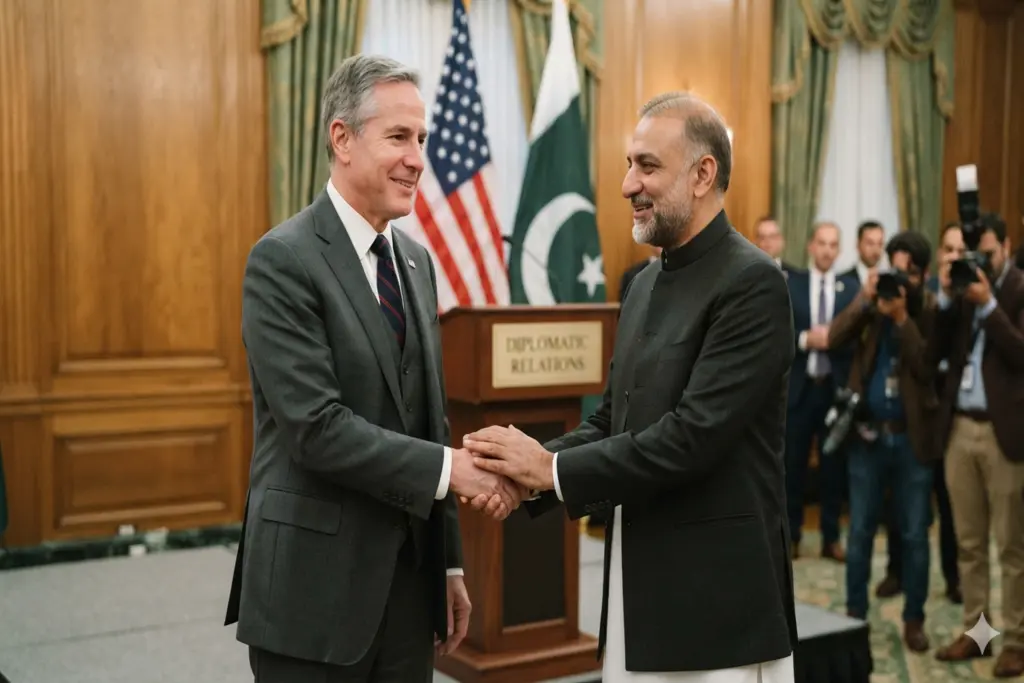
There has been a fast pace of diplomatic and economic dialogue between Washington and Islamabad. The United States and Pakistan recently held the Fourth meeting in the series of Counterterrorism Dialogue in Washington, D.C., where they reaffirmed their mutual efforts to counter regional terrorist groups and enhance security architecture. In parallel with these strategic security discussions, advanced bilateral discussions are taking place to conclude a bilateral trade deal aimed at redefining economic cooperation.
Counterterrorism Dialogue and Pressing Regional Security Challenges
US Coordinator for Counterterrorism Ambassador Gregory LoGerfo and Pakistan’s Special Secretary in the Foreign Ministry Ambassador Nabeel Munir headed the critical security dialogue. The delegations both held in-depth discussions on the existing threat condition, according to a joint statement issued by the US State Department.
Sensitive issues such as strengthening border security, cooperation on intelligence sharing and the fight against terrorist facilitation networks were very much in the conversation. The joint statement made it clear that there were several militant groups as threats to regional and global peace, among them are:
ISIS-Khorasan (ISIS-K)
Al Qaeda
Tehreek-i-Taliban Pakistan (TTP)
Balochistan Liberation Army (BLA) and its affiliates
These comprehensive deliberations took place at a time when Islamabad was grappling with growing internal security issues, according to Pakistan’s Foreign Office. According to data from the Pakistan Institute for Conflict and Security Studies, July 2026 was the worst month in recent times as 205 people, including 112 security personnel, were killed. The renewed engagement is a major shift in the US-Pakistan diplomatic relationship, and effectively addresses the diplomatic tensions that have arisen after the US’ withdrawal from Afghanistan in 2021.
<blockquote class=”twitter-tweet”><p lang=”en” dir=”ltr”>Pakistan and the U.S. convened the Fourth Round of Counterterrorism Dialogue in Washington D.C. The two sides held extensive deliberations on the regional and global terrorist threat and pledged to deepen counterterrorism collaboration both bilaterally and at multilateral fora. <a href=”https://t.co/h6Vvxr5gNm”>pic.twitter.com/h6Vvxr5gNm</a></p>— Ministry of Foreign Affairs – Pakistan (@ForeignOfficePk) <a href=”https://x.com/ForeignOfficePk/status/2084844321376022868?ref_src=twsrc%5Etfw”>August 5, 2026</a></blockquote> <script async src=”https://platform.x.com/widgets.js” charset=”utf-8″></script>
Economic Cooperation: Finalizing the Reciprocal Trade Framework
Security delegations had a meeting in Washington while the Finance Minister Muhammad Aurangzeb met the U.S. Trade Representative (USTR) Ambassador Jamieson Greer in a parallel virtual meeting in Islamabad. This meeting was focused on updating and speeding up discussions on a new bilateral economic roadmap.
This meeting came in the wake of Aurangzeb’s recent visit to Washington, where he had key discussions with the USTR, US Export-Import Bank (Exim), US International Development Finance Corporation (DFC), and the International Monetary Fund (IMF). The ongoing technical talks are aimed at achieving mutual market access, optimizing tariff packages, and promoting private sector investment.
The Finance Minister reiterated that Pakistan’s export based growth policy remains very much dependent on a strong trade and investment partnership with the U.S. This is expected to strengthen resilience in the macro-economic sector, stabilise the local economy and provide a good avenue for commercial pipelines for both countries.
Regulatory Compliance, Labor Reforms, and US Tariffs
One of the highlights of the economic dialogue was about the standards of labor and compliance with the regulations. Ambassador Greer commended Pakistan’s continuing legislative and enforcement efforts towards the elimination of forced labour.
Given the recent import tariffs imposed by Washington on 60 countries for non-compliance with forced labor, this issue is a very significant economic matter. Pakistan was strategically placed in the lower 10 percent tariff tier. Included in this category are countries that have banned the importation of goods made with forced labour, or that have promised to align their standards of compliance with those of the United States in the context of reciprocal trade agreements.
An effective overcoming of these regulatory challenges highlights a greater transformation in relation between the United States and Pakistan. Both capitals are actively trying to move beyond a transactional, security-focused relationship and to diversify their relationship to include trade, infrastructure financing, climate resilience and regional diplomacy.