


The Government of Sindh has rolled out one of the most substantial clean energy welfare initiatives in Pakistan’s history under its Energy Security & Solar Empowerment Initiative. Launched on the explicit directives of Pakistan Peoples Party (PPP) Chairman Bilawal Bhutto Zardari, this massive Rs. 18.20 billion solar project aims to shield the province’s most vulnerable populations from inflated electricity bills and chronic power outages.
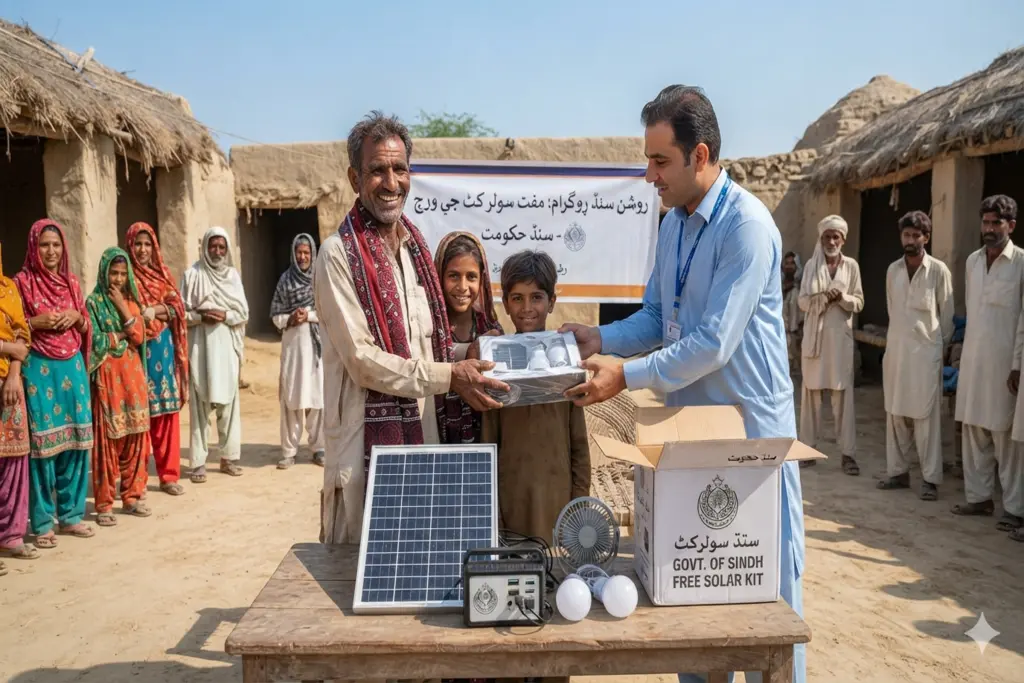
The targeted welfare scheme is actively delivering 275,000 completely free mini Solar Home System (SHS) kits to economically disadvantaged families. This detailed guide breaks down the strict eligibility criteria, targeted geographic regions, complete system specifications, and the official program deadline.
Solar Kits Comprehensive Eligibility Criteria: Who Qualifies?
To ensure complete merit-based transparency and rule out discrepancies, the Sindh Energy Department uses an established tracking framework in collaboration with the Sindh Rural Support Organisation (SRSO). Families are prioritized based on verified socio-economic metrics:
BISP Registered Beneficiaries: Prime priority is given to impoverished families actively registered with the Benazir Income Support Programme (BISP).
Protected Electricity Consumers: Grid-connected households that have maintained a clean power record and consume up to 100 units of electricity per month qualify.
Zero-Income & Vulnerable Segments: Special preference is designated for widows, disabled citizens, and families living below the absolute poverty line who have no regular source of income.
Solar Kits Scheme Eligible Areas and Districts
The distribution of the 275,000 free solar systems is split into two structural groups to optimize energy access:
Off-Grid Regions (132,000 Households): Focused entirely on far-flung, remote, desert, mountainous, and riverine areas that completely lack foundational access to national grid transmission lines.
On-Grid Regions: Low-income, protected consumers in urban slums and rural areas facing high energy poverty. (143,000 Households)
All 30 districts of Sindh are covered under the project. Thousands of units have already been installed in high need districts with massive installation drives. The statistics of the province, provided by the recently released figures, show that Tharparkar has got the most kits after Sanghar, Umerkot, Mirpurkhas, Naushehro Feroze, Shaheed Benazirabad, Ghotki and Malir.
Technical Specifications of the Free Solar Kit
Each household selected under the Sindh Solar Energy Project (SSEP) receives a standardized, highly efficient mini solar setup. The kit is fully optimized to run a household’s basic utility needs without any reliance on grid power:
Solar Panel Array: High efficiency, premium 180 watt solar panel designed for maximum power generation in extreme local temperatures.
Storage Battery: A reliable overnight back-up power Lithium Battery package that lasts longer than conventional lead-acid batteries.
Appliances Included: One energy-efficient DC fan and a high lumen LED light/set of bulbs will be included in each bundle.
Charging Hub: Integrated ports for multi-device mobile phone charging alongside an automated charge controller system.
Solar Kits Official Project Completion Deadline
The provincial rollout formally commenced in April 2025. To ensure fast implementation, the Senior Minister for Sindh, Dr. Sharjeel Inam Memon stated that the final deadline to install all of the 275,000 systems throughout the province is set for June 2027. Chief Minister Sheikh Syed Muazzem Hussain Ali ordered the Energy Department to increase the installation rate per day while urging the administrative tracking system to closely supervise the field teams for no delay in relaying the underprivileged citizens.