

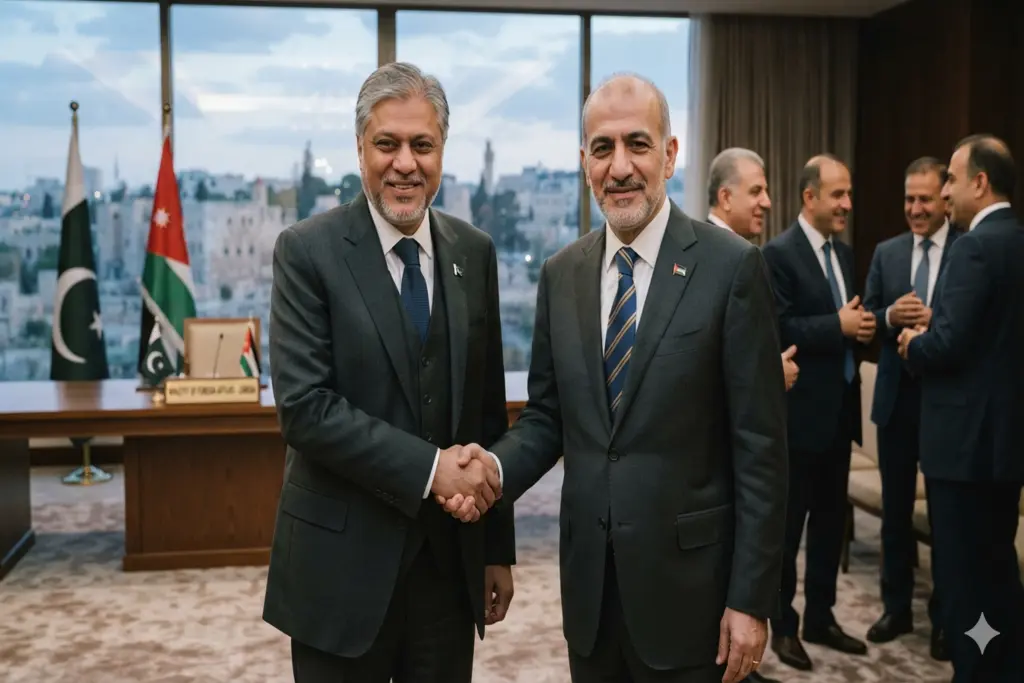
Senator Mohammad Ishaq Dar, the Deputy Prime Minister and Foreign Minister of Pakistan, has made the trip to Amman, the capital of the Hashemite Kingdom of Jordan, on an important diplomatic errand. This visit comes amidst heightened tensions in the Middle East, highlighting Islamabad’s proactive efforts in promoting peace and unity in the region and building Islamic unity.
Ishaq Dar’s main purpose with the Jordanian visit is to attend the critical Ministerial Meeting on Jerusalem organised by the Jordanian government. The summit is an assembly of high-ranking Muslim foreign ministers from around the Muslim world to discuss structural threats to the historic and legal rights of the city of Al-Quds Al-Sharif (Jerusalem) and the resulting humanitarian crisis in Occupied Palestinian Territory.
Official Reception and Protocol in Amman
Deputy PM Ishaq Dar was welcomed with a diplomatic formal and warm reception upon arrival in Amman. He was greeted by H.E. Ms. Saja Almajali, Director of the Human Rights Directorate at the Jordanian Ministry of Foreign Affairs and Expatriates at the airport.
Major General (R) Khurram Sarfraz Khan, the Pakistani Ambassador to Jordan, was accompanied by top officials from the Embassy of Pakistan Amman in Jordan to represent the Pakistani diplomatic missions at the event. The cordiality and brotherly cooperation between Pakistan and Jordan is rooted in mutual respect and shared visions on some fundamental issues facing the international community, which are visible in the high level reception.
Deputy Prime Minister/Foreign Minister Senator Mohammad Ishaq Dar @MIshaqDar50 joined fellow Foreign Ministers from the Arab League and the Group of Muslim Countries for the official group photo at the Ministerial Meeting on Jerusalem in Amman. pic.twitter.com/yFX0PTHhbU
— Ministry of Foreign Affairs – Pakistan (@ForeignOfficePk) August 5, 2026
The Jerusalem Ministerial Meeting: Driving Pakistan’s Stance
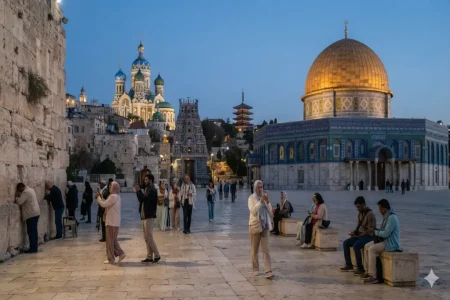
The highlights of Senator Dar’s agenda are the Ministerial Meeting on Jerusalem. This conference is organized under the auspices of the Hashemite Kingdom with the view of forming a consensus of the international community against any illegal settlement, demographic changes and violation of holy sites in Jerusalem.
In the sessions, Senator Dar will make Pakistan’s clear-cut policy statement which is based on the following pillars:
Protection of Holy Sites: Calling for unconditional respect for the historical and legal condition of Al-Aqsa Mosque compound.
2 State Solution: Reiterate Pakistan’s firm commitment towards the establishment of an independent, viable and contiguous Palestinian State with Al-Quds Al-Sharif as its capital based on the 1967 borders.
Humanitarian Access: Urging the international community to provide immediate and unhindered relief access to Gaza and affected West Bank areas.
Royal Audience with His Majesty King Abdullah II
This was a much anticipated part of the visit of Mr. Ishaq Dar to Jordan where he was expected to meet His Majesty King Abdullah II. In this Royal Audience, the Deputy Prime Minister will extend the greetings and appreciation of Pakistan’s leadership and people on the historic status of Jordan as the custodian of the Islamic and Christian holy sites in Jerusalem.
When Senator Dar and King Abdullah II meet, they will discuss a number of strategies of interest between the two nations, such as a plan for expanding economic cooperation, trade relations and defense cooperation. Moreover, both leaders will exchange opinions on the Middle East security matrices, charting future avenues for joint efforts to defuse the rising security tensions in the region.
Side-Line Bilateral Engagements with Global Counterparts
In addition to the main summit room, Senator Dar is also carrying out a heavy agenda of bilateral talks with other senior Foreign Ministers at the event. Such side-line contacts are crucial to synchronise diplomatic efforts in the lead up to key UN and Organisation of Islamic Cooperation (OIC) meetings.
The discussions are very much centered on regional conflict resolution, diversification of trade and deepening multilateral cooperation. In its direct interactions with the Arab and Islamic nations, Pakistan is further establishing itself as a key regional peace, stability, and economic resilience builder.