

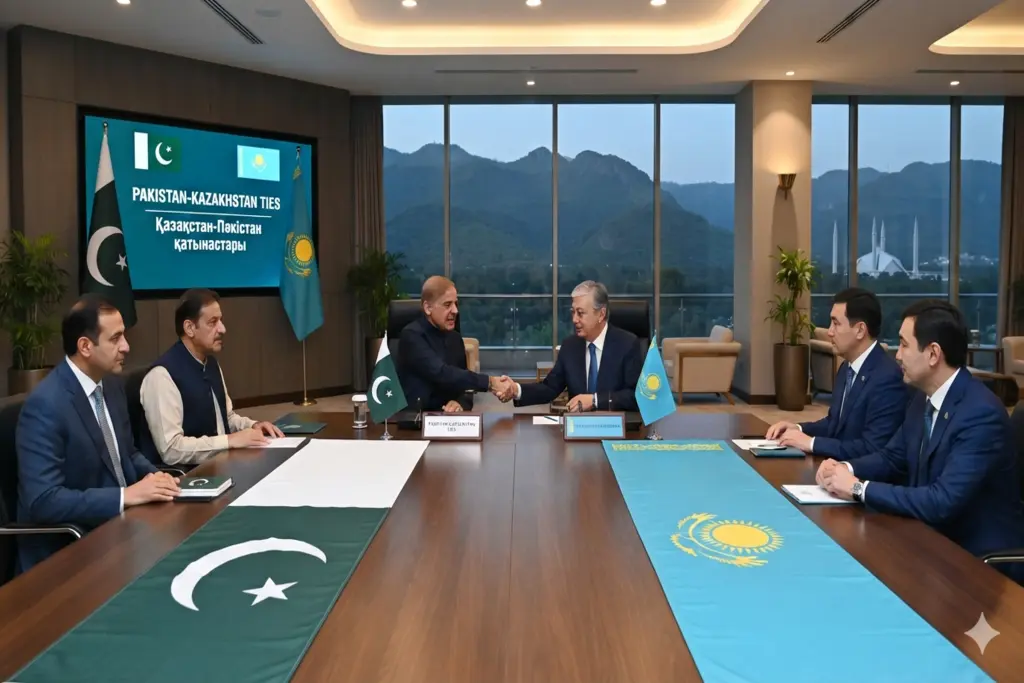
Prime Minister Shehbaz Sharif this week renewed focus on Central Asia, reiterating Pakistan’s interest in strengthening ties with Kazakhstan. It was a farewell meeting with outgoing Kazakh envoy Yerzhan Kistafin but the message was far more than diplomatic politeness. The growing Pakistan Kazakhstan partnership is starting to look like more than just polite talk for a country trying to open new export markets and reduce its dependence on a handful of traditional trading partners.
What Really Happened
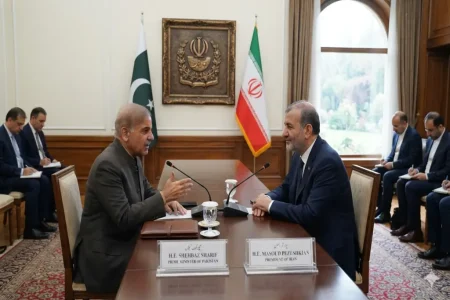
Ambassador Kistafin met Shehbaz Sharif at the conclusion of his tenure at the PM House in Islamabad. The Prime Minister thanked him for bolstering ties between the two countries and gave him credit for helping to organize President Kassym-Jomart Tokayev’s visit to Pakistan in February this year, which took relations to the level of a full strategic partnership. There was no routine send-off, as Deputy Prime Minister Ishaq Dar, SAPM Tariq Fatemi and Foreign Secretary Amna Baloch were also there. It was a sign that Islamabad wants continuity in this relationship, even when ambassadors change.
Why it matters to ordinary Pakistanis
It’s easy to dismiss diplomatic reaffirmations as background noise, but the details are important for everyday trade and jobs. During President Tokayev’s visit in February, the two sides signed 37 memoranda of understanding with a target of increasing bilateral trade from around 250 million dollars to 1 billion dollars within a year. That is a 4-times jump and it relies on a follow-through, just like the kind PM Shehbaz reaffirmed this week.
Where there’s opportunity
•Trade and transit: Pakistan is opening up the Gwadar and Karachi ports to Kazakhstan, making it Central Asia’s route to the sea.
•Energy cooperation: Discussions on energy imports and joint projects continue, which could help ease Pakistan’s chronic power shortages.
•Education and Exchange: Further scholarships and student exchange programs are to be developed, on the lines of the existing arrangements with other Central Asian states.
•Connectivity: Links by rail and road such as the Belarus-Russia-Kazakhstan-Uzbekistan-Afghanistan-Pakistan corridor remain a key element of the plan.
A word of caution to Pakistani readers
Trade targets between governments are not automatically business on the ground. Pakistani exporters, especially small and medium-sized enterprises, still face limited banking channels for Central Asian trade, unclear customs procedures and weak direct transport links, in particular. To benefit from this Kazakhstan partnership, one should keep a tab on the updates from the State Bank of Pakistan, Trade Development Authority of Pakistan (TDAP) and Ministry of Commerce. Don’t assume that the deal alone will open doors.
Quick Checklist for Traders and Students
•To receive updates on trade facilitation with Kazakhstan, register with TDAP.
•Watch this space for news of new scholarships through HEC and the Kazakh embassy.
•Central Asia transit arrangements: Stay tuned to Gwadar Port Authority for updates.
•Watch the rupee-tenge exchange mechanisms develop as banking links develop.
Conclusion
The farewell meeting itself was a small diplomatic formality but it foreshadows a bigger shift. Pakistan is keen to turn its decades-old friendship with Kazakhstan into concrete trade and connectivity benefits and this week’s reaffirmation keeps that momentum alive as a new ambassador takes charge. The opportunity for Pakistani businesses and students is real but it will only pay off if government follow-through equals the warmth of these diplomatic statements.