



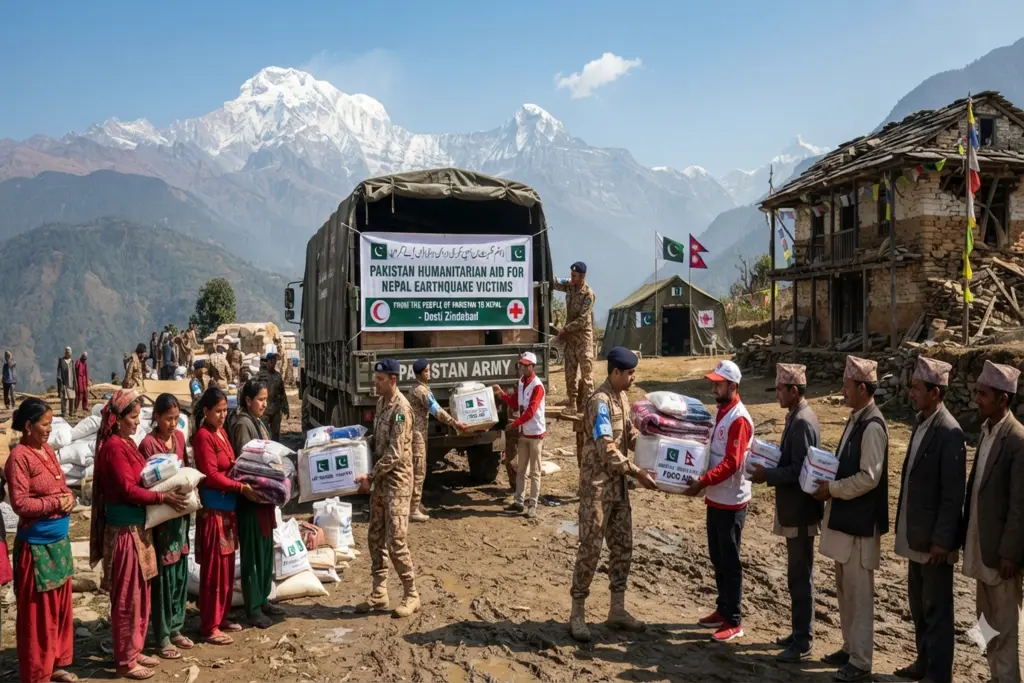
The government of Pakistan has unquestionably demonstrated its concern for the people of Nepal by sending a huge consignment of 100 tons of humanitarian aid to Nepal in an unprecedented pace of disaster diplomacy with a display of regional solidarity. The emergency deployment comes after widespread flash floods and deadly landslides that have ravaged the Himalayan country due to unpredictable surges in the monsoon rains, which have caused extensive damage to infrastructure.
The relief framework was designed, assembled and put on a chartered aircraft that was dispatched directly from Pakistan to Kathmandu under the leadership of the Prime Minister Muhammad Shehbaz Sharif. The entire trans – border logistical operation was managed by the National Disaster Management Authority and all life saving supplies were not allowed to pass through the normal shipping friction but arrived directly at Tribhuvan International Airport for immediate distribution to the field.
High-Profile Send-Off Ceremony at Islamabad International Airport
Prior to the flight’s departure, a formal state send-off ceremony was organized at the Islamabad International Airport to mark the launch of the air corridor. The Minister for Parliamentary Affairs, Dr. Tariq Fazal Chaudhry, hosted the session as the chief guest.
The technical deployment session brought together key diplomatic and disaster management managers:
The Ambassador of Nepal to Pakistan: Extending profound institutional gratitude to the federal cabinet, the NDMA, and the citizens of Pakistan for providing automated logistical relief during a critical macroeconomic and natural crisis.
Ministry of Foreign Affairs Directors: Orchestrating paperless flight clearances and cross-border flight paths to secure zero-delay customs processing.
Senior NDMA Logistics Managers: Verifying weight logs, cryptographic tracking numbers, and compliance metrics for all airborne cargo.
Pakistan has dispatched 100 tons of humanitarian assistance to Nepal to support relief efforts following the recent devastating floods and landslides@PakinNepal @ndmapk @ForeignOfficePk @MofaNepal #RadioPakistan #News #NDMA #HumanitarianAid #FloodRelief… pic.twitter.com/xlSHHJsfz8
— Radio Pakistan (@RadioPakistan) September 6, 2026
Technical Inventory and Cargo Breakdown of the 100-Ton Consignment
According to data sheets published by the NDMA, the cargo manifest was systematically curated based on real-time needs assessments transmitted from Kathmandu’s disaster logs. The 100-ton payload targets immediate shelter stabilization, medical triage, and public health security across displaced communities.
The specialized cargo includes four high-priority asset categories:
Weather Resistant Family tents: Industrial strength, waterproof, windproof tents that quickly create base camps in mountainous landslides for families.
Thermal Blankets and Ground Mats: Mats with high density insulation to keep the vulnerable survivors warm in high altitude areas.
Advanced Family Hygiene Kits: Clean water tablets, antibacterial soap and other personal hygiene supplies contained in a sanitization unit designed to reduce the spread of water borne bacterial epidemics in flood areas.
Emergency Medical Cargo: Stocks of broad-spectrum antibiotics, surgical dressings, analgesics and first aid kits that are to be added to local clinical networks.
Dr. Tariq Fazal Chaudhry reiterated that Pakistan’s relationship with Nepal is beyond the usual diplomatic protocols when he addressed the airport tarmac. He said that the air deployment is a testament to Pakistan’s proactive efforts in the region and was a response to the country’s readiness to extend its disaster response capability to ensure the safety and human welfare of its country neighbors in the event of unforeseen climate-related disasters.