



The State Bank of Pakistan (SBP) has well established Anti-Money Laundering (AML) and Know Your Customer (KYC) policies in the national financial services industry. That means millions of consumers suddenly have to deal with having their debit card declined at the ATM, or having a message appear on their mobile banking app saying their account has been “blocked” or “frozen.That leaves thousands of consumers in a familiar “frustration” when their debit card is declined at an ATM or when an “Account Blocked” or “Frozen” message appears on their mobile banking application. Unexpected money freezings can be extremely upsetting and stressful, particularly if you have to make a timely payment or business deal.
Should your account be closed or restricted by the HBL, UBL, Meezan Bank, Bank Alfalah or other commercial bank in Pakistan, the issue can be addressed in a clear legal manner.
Common Reasons Why Pakistani Bank Accounts Get Blocked
Before initiating the recovery process, you must pinpoint the exact regulatory trigger that prompted your bank’s compliance or security department to lock your funds:
Dormant Status (Inactivity): Under SBP rules, if an account shows zero customer-initiated debit or credit transactions for a continuous period of 12 calendar months, it is automatically classified as “Dormant” to prevent unauthorized identity theft.
Expired Biometric Verification: Commercial banks are legally mandated to refresh biometric records of their customers periodically. If you missed the SMS alerts or deadliness to scan your fingerprints, your account experiences a temporary freeze.
Outdated KYC Profiles or Expired CNIC: If your Computerized National Identity Card (CNIC) has expired at NADRA, or if your registered employment status, residential address, or annual income brackets have changed without an update in the bank’s database, the profile becomes non-compliant.
Suspicious Transactional Velocity: Sudden, massive cash inflows or international wire transfers that do not align with your declared source of income will automatically trigger internal compliance flags. Similarly, using your account for illegal Cryptocurrency (P2P trading via Binance) violates SBP directives and leads to an immediate, permanent freeze.
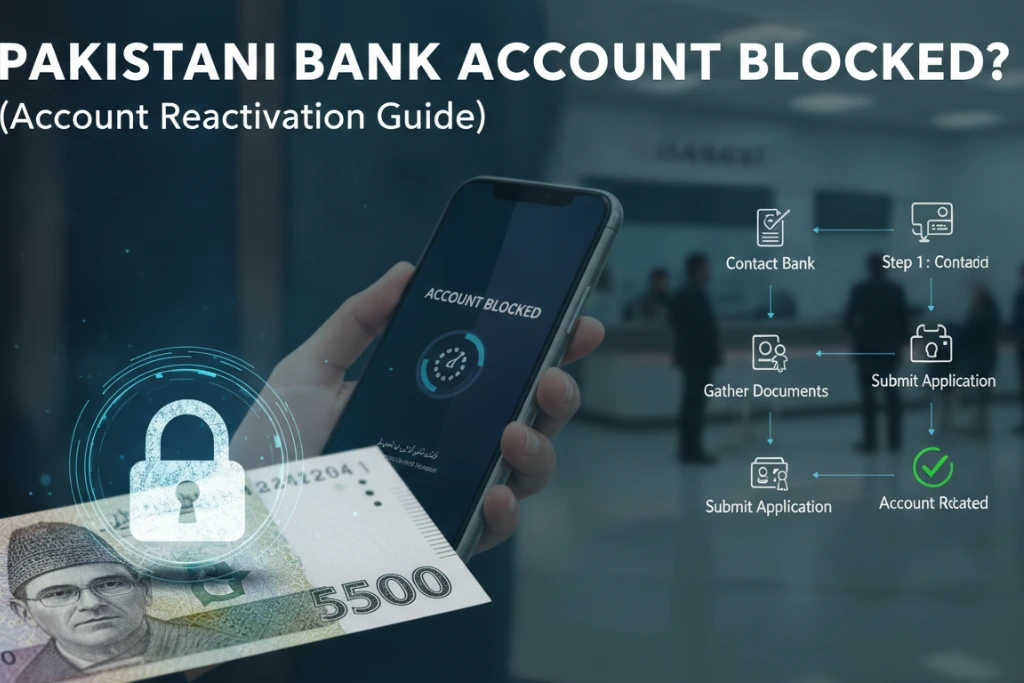
Step-by-Step Blocked Bank Account Reactivation Guide
To unfreeze your financial assets and restore full transactional capability, systematically execute the following action plan:
Contact Your Bank to Identify the Restrictive Code
Immediately call your bank’s official 24/7 customer care helpline or visit your specific “Home Branch” (the physical location where you originally opened the account). Request the customer service officer to check the system and give you the exact “Reason Code” or administrative flag placed on your account.
Update Your Bio-Data and Complete Biometric Scanning
If the restriction stems from basic profile non-compliance or an expired identity card:
Bring your original, valid, newly issued NADRA CNIC to the branch.
Request a KYC Update / Account Reactivation Form.
Place your thumb on the biometric machine to verify your identity directly against the NADRA system.
Note: Many modern institutions now allow this biometric update to be completed remotely via their official mobile banking apps using your smartphone camera.
Provide Substantive Proof of Income
If your account was blocked due to an unverified transaction or high-volume velocity, you must legally satisfy the Branch Manager regarding the source of funds:
Salaried Individuals: Provide your latest three months’ official salary slips or a signed, stamped employment certificate.
Business Owners / Freelancers: Present your official FBR National Tax Number (NTN) certificate, active tax filing proofs, corporate letterheads, or verified milestone invoices from freelance networks like Upwork or Fiverr.
Execute a Mandatory Activation Transaction
Once the compliance office reviews and approves your updated paperwork, they will lift the administrative hold. To finalize the blocked bank account reactivation, you must conduct a physical, customer-initiated transaction within 24 to 48 hours. Deposit or withdraw a small amount (e.g., Rs. 500) via a checkbook or an ATM to signal the system that the user is actively monitoring the account.
Proactive Tips to Keep Your Account Active
Perform Regular Check-ins: Even if you use an account purely for secondary savings, execute at least one small utility bill payment or cash transfer every six months to completely avoid dormant flags.
Promptly Report Changes: The moment your phone number changes, your passport is renewed, or your CNIC gets updated by NADRA, visit your bank to log the fresh records immediately.
Steer Clear of Crypto P2P: Avoid routing any peer-to-peer digital asset exchanges through your formal bank accounts, as Pakistani banks employ automated monitoring filters that instantly block accounts tied to crypto matching-engines.