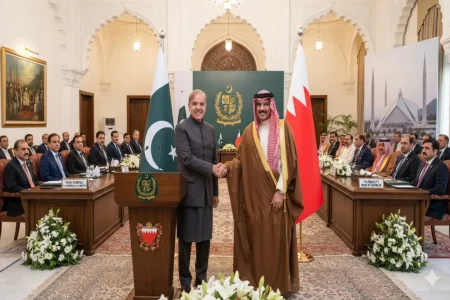




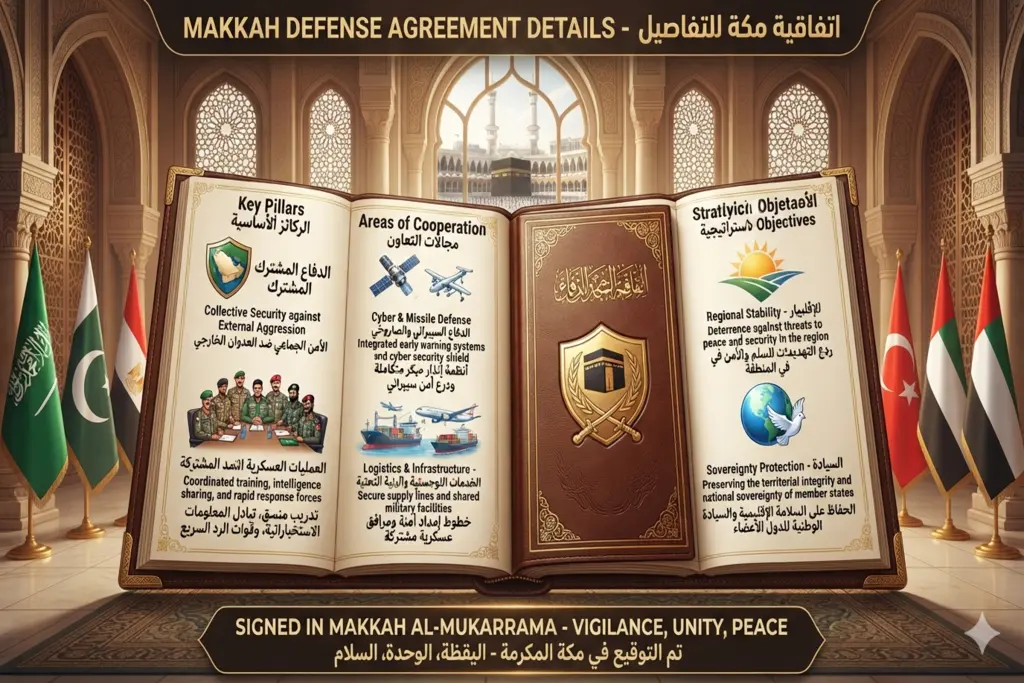
Turkish Foreign Minister Hakan Fidan has officially clarified a vital strategic aspect of the recently signed Makkah Joint Defense Agreement between Turkey, Saudi Arabia, and Pakistan. Following intense international speculation comparing the trilateral treaty to a NATO-style absolute defense pact, Ankara’s official disclosure has shed new light on the architectural scope of this historic alliance. Turkey has explicitly confirmed that the mutual treaty is fundamentally defensive and stabilizing, designed to reinforce regional autonomy rather than isolate or target any particular regional power.
Turkey’s Official Clarification: No Written Common Threat
Turkish Foreign Minister Hakan Fidan gave a high-level briefing to international media where he dispelled the widespread rumours that the pact was being formed as an anti-X alliance – namely against Iran. The Makkah Defense Agreement is a confidential agreement which doesn’t include any declaration of a “common threat,” or any particular enemy state,” Fidan stressed.
This is a strategic message sent by Ankara to keep its delicate diplomacy in the Middle East alive, and to defuse geopolitical fears. The Turkish government believes that the overall objective of the Makkah triad is to build a regional “indigenous security structure” that ensures the collective defence response comes only when there is an “unprovoked external armed aggression against a member state”.
Egypt Eyed as the Next Potential Partner in the Alliance
Perhaps the most significant detail confirmed by the Turkish Foreign Ministry is that this defense bloc is structurally open to future expansion. Minister Hakan Fidan revealed that Egypt is viewed as a natural next partner to join this evolving collective security umbrella.
Following years of diplomatic normalization, relations between Ankara and Cairo have strengthened substantially. Integrating Egypt—a nation that commands Africa’s most formidable standing military and directly controls the Suez Canal—would dramatically expand the strategic reach of the alliance. This expansion would create an unbroken maritime security chain extending from the Mediterranean and Red Seas through the Persian Gulf and into the Indian Ocean.
Operational Pillars: Technology Transfer and Shared Deterrence
According to the details confirmed by Turkish defense analysts, the pact operates primarily as an advanced industrial and technological cooperative framework, which will mature through the following operational phases:
Aerospace Integration: Turkey is keen on integrating both Pakistan and Saudi Arabia into its leading fifth-generation national fighter jet program (KAAN) as part of the process to create a joint air combat fleet.
Maritime Power Projection: Building of a coherent Red Sea and Gulf of Aden patrol network to protect the global transport of commercial shipping from non-state actors.
Military Self-Reliance: Saudi Arabia and Pakistan’s mission to produce advanced Turkish unmanned aerial vehicles (UAVs) and naval warships to gradually reduce Saudi Arabia’s and Pakistan’s dependence on Western defense industry supply chains.