


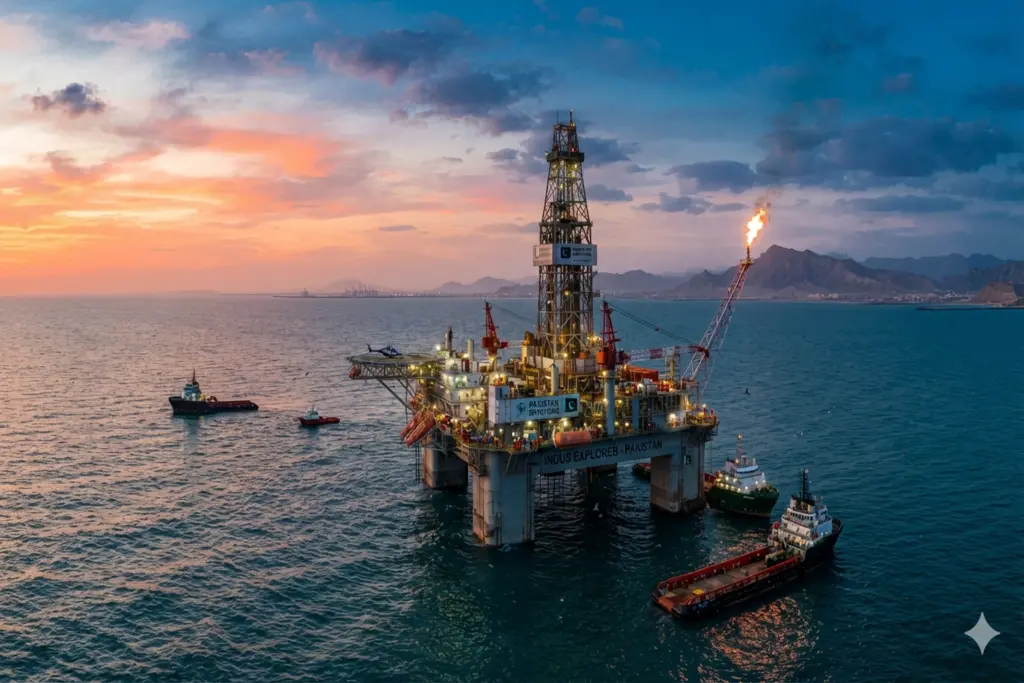
The Turkish Petroleum Corporation (TPAO), a state-owned petroleum company, will begin deep-sea oil and gas exploration through offshore drilling in Pakistan in a major economic breakthrough to help resolve the serious energy crisis and minimize the use of costly imported fuel. During a press conference in Lahore, Federal Minister for Petroleum Ali Pervaiz Malik announced the strategic partnership. The venture is the culmination of a 20-year stoppage in deep sea exploration in Pakistan’s waters, and will pave the way for a massive foreign direct investment (FDI) and scientific collaboration between the two brotherly nations.
TPAO’s Financial Commitment and Exploration Roadmap
The Petroleum Minister has said that Turkish Petroleum will make an initial foreign direct investment of about USD 120 million to USD 130 million to finance just the initial drilling phase and advanced seismic testing. These test wells will likely expand to billions of dollars throughout the production life if they turn out to be commercially successful and contain large amounts of hydrocarbons.
The upcoming arrival of specialised Turkish drilling vessels and research vessels in September/October is a direct implementation of the joint-venture agreements that were finalised at the Islamabad Minerals Investment Forum (IMIF) in December 2025. In this trilateral deal, TPAO is proceeding along with top class state enterprises of Pakistan such as Oil and Gas Development Company Limited (OGDCL), Pakistan Petroleum Limited (PPL) and Mari Petroleum Company Limited (MPCL) and is primarily concentrating on the un-explored deep water blocks in Indus and Makran basin.
Geostrategic Importance of Deep-Sea Reserves for Pakistan’s Economy
Pakistan currently finds itself in a highly vulnerable economic position due to its extreme dependence on imported energy. The country imports nearly 90% of its crude oil and Liquefied Natural Gas (LNG) to sustain domestic and industrial needs. Data reveals the gravity of the local energy deficit:
National Demand: Pakistan consumes approximately 500,000 barrels of oil per day.
Domestic Output: Local extraction accounts for only about 70,000 barrels per day.
This massive supply gap drains billions of dollars from Pakistan’s foreign exchange reserves every fiscal year, inflating the national circular debt. Successful exploration in the offshore blocks could fundamentally transform Pakistan from an energy-starved importer into a self-reliant producer, ultimately driving down utility costs and local petrol prices significantly.
SIFC Support and the Broader Pak-Turk Strategic Nexus
Minister Ali Pervaiz Malik highlighted that this rapid execution of energy cooperation is heavily backed by Pakistan’s Special Investment Facilitation Council (SIFC) and falls in line with the broader spirit of the newly signed Makkah Joint Defense Agreement between Pakistan, Turkey, and Saudi Arabia. Under the oversight of Prime Minister Shehbaz Sharif and Army Chief Field Marshal Asim Munir, Pakistan is actively leveraging its defense alliances to secure long-term industrial and economic benefits. Furthermore, the ministry revealed that a premier international consulting firm has been hired to design a comprehensive restructuring roadmap for Pakistan’s overall power and energy sector, which will be unveiled to global investors shortly.