




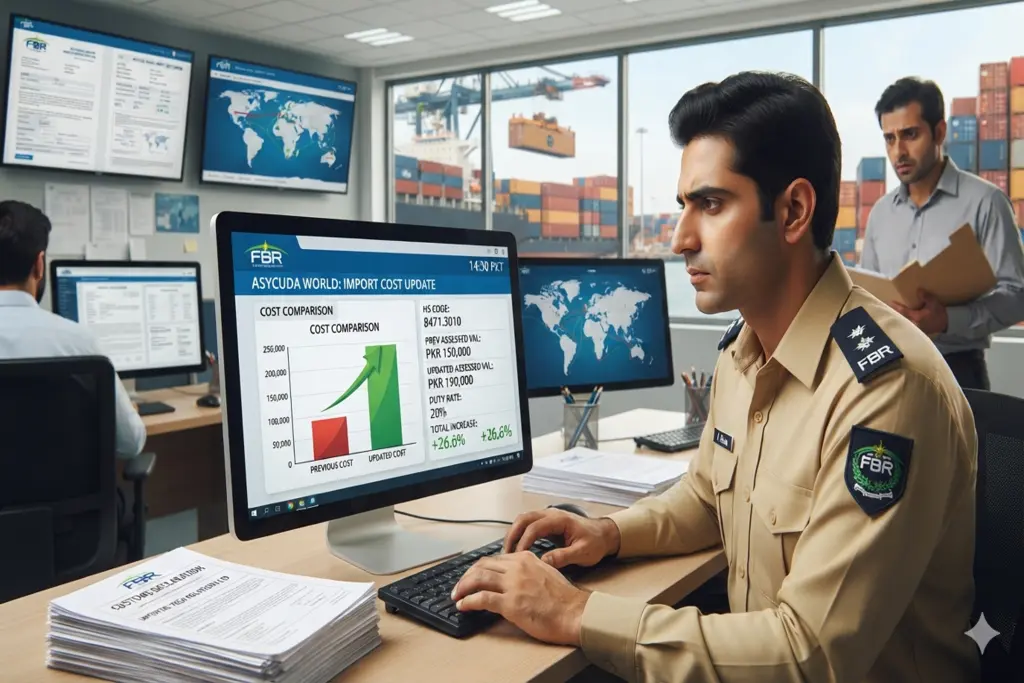
The Federal Board of Revenue (FBR) has officially announced the customs valuation for imports of Polyester Filament Yarn (PFY) in accordance with international market trends. The new Valuation Ruling (No. 2101/2026) replaces the previous and obsolete Valuation Ruling No. 2069/2025 issued by Directorate General of Customs Valuation, Karachi. The move, which was taken under Section 25A of the Customs Act, 1969, introduces a higher threshold value for imports to eliminate under-invoicing, better reflect international price increases and safeguard the domestic manufacturing industry.
Surging Raw Material Costs and Market Disruption
The recalculation of the structure has followed a period of extensive discussions with various stakeholders like Federation of Pakistan Chambers of Commerce & Industry (FPCCI), commercial importers and internal yarn manufacturers. The FBR received heavy lobbying from local producers, who pointed to its sources of data, which showed significant rise in global prices of the petrochemical feedstocks – namely purified terephthalic acid (PTA) and mono ethylene glycol (MEG). Domestic manufacturers claimed that the old valuation guidelines have facilitated foreign exporters to compete with local production in Pakistan and given them an unfair opportunity to sell their synthetic yarn at low prices, which is threatening investments in the domestic market.
On the other hand, the commercial importers and fabric weavers, located downstream, resisted in the regulatory hearings. They said it would be inequitable to jack up the base customs values while there is an economic stabilisation programme in progress and the textile sector would be indirectly affected by the cost of raw materials. Based on the outcome of the product evaluation of the clearance data, the price indices of international trade and the formula used in manufacturing, the Directorate decided that the old ruling did not reflect the actual transaction value of international trade.
Implementation of the Revised Customs Benchmarks
To ensure legal compliance and uniformity at all major ports of entry, the FBR’s new ruling sets structured minimum Cost and Freight (C&F) values for various grades of Polyester Filament Yarn.
Key administrative and technical features of the newly enforced valuation framework include:
Petrochemical Tracking: Import values are directly indexed against current international market spot prices for PTA and MEG, ensuring fluid adjustments.
Premium on Dyed Yarn: A mandatory premium of US$ 0.10 per kilogram will be added to the baseline C&F customs value for all imported dyed yarn variations.
Transaction Value Protection: If a commercial importer declares a higher transaction value than the newly established FBR minimum baseline, customs authorities will assess duties based on that higher declared value under Section 25(1).
Sequential Valuation Methodology: In cases where direct transaction data was missing, the FBR utilized the “Computed Value Method” under Section 25(8) of the Customs Act, tracing back production costs plus standard profit margins.
Economic Impact on the Textile Supply Chain
The FBR’s decision creates a dual-effect across Pakistan’s vital textile sector. Local spinning mills and synthetic yarn plants are major beneficiaries, as the higher customs baseline creates a level playing field against cheap imports, particularly from regional manufacturing hubs. However, non-integrated garment and fabric exporters express concern. Because Polyester Filament Yarn is a core component in sportswear, synthetic blends, and home textiles, the increased import cost could marginally increase overall production expenses. This raises fears regarding the price competitiveness of Pakistani finished textile exports in highly contested Western consumer markets.