

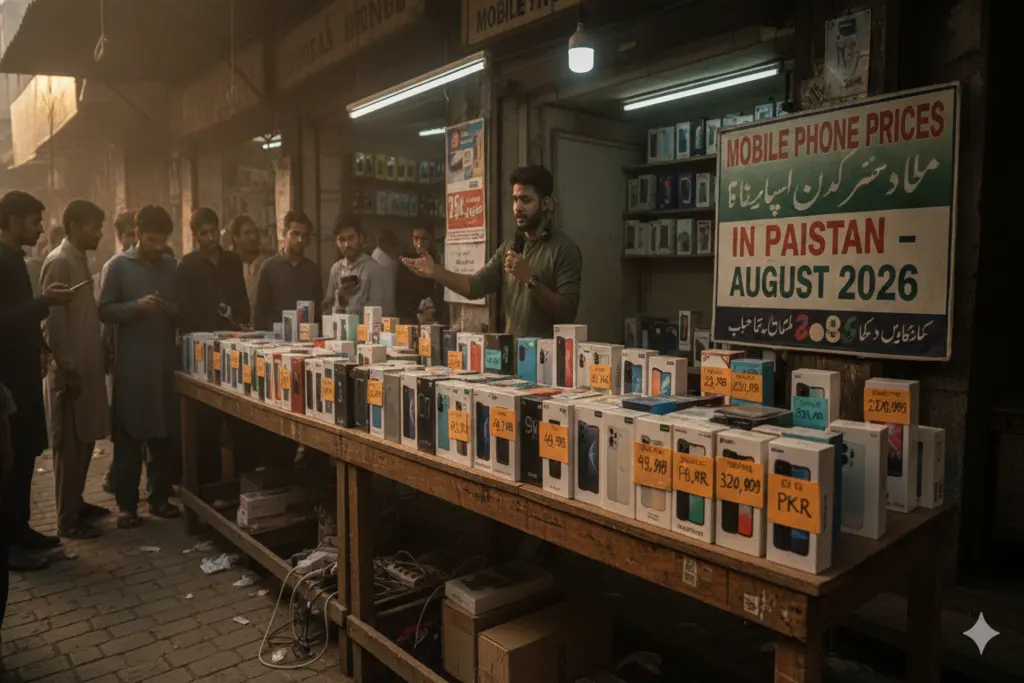
The Government of Pakistan has presented its federal budget for 2026-27, which includes several tough fiscal measures aimed at adhering to international stabilization guidelines. The telecom and mobile phone industry is one of the most affected industries. The Federal Board of Revenue (FBR) and the Pakistan Telecommunication Authority (PTA) have jointly amended the existing customs duties framework, regulatory duties framework, and sales tax framework of mobile devices.
For people who use technology, those who are fascinated with it and those who import it commercially, this is a revolutionary change. Getting a new smartphone registered or buying an imported device will now cost significantly more. Here is an in-depth breakdown of the new PTA tax slabs and how they directly impact mobile phone prices in Pakistan.
Decoding the New PTA Tax Slabs and Duty Structure
The Budget 2026-27 completely eliminates previous uniform concessions on commercial smartphone imports. Rather, it offers a very aggressively structured ad valorem (value-based) tax system based on the Cost and Freight (C&F) value of the device in US dollars.
The revised tax rates can be broken down into three price buckets:
Low-End & Feature Phones (Up to $100 C&F): These are basic mobile devices and entry level smartphones costing less than $100 (Pkr 28,000/-) will have reduced FST and an additional 15% in regulatory costs.
The mid-range Smartphones ($100 to $500 C&F) market, comprising the majority user base, has a compounded import tax burden of up to 25%, with the 18% standard General Sales Tax (GST) being the heaviest of the taxes.
Premium & Flagship Devices ($500+ C&F): The steepest rise is for flagship devices like the Apple iPhone 15/16 series and Samsung Galaxy S-series. Flat customs duties on these luxury devices have escalated to between 35% and 40%, pushing overall legal PTA approval fees to historic highs.
Furthermore, international travelers bringing a single personal device into Pakistan will experience a 10% to 20% tax hike when registering via passport or CNIC after their initial 60-day window expires.
Post-Budget Mobile Price and PTA Tax Estimates
To give you a clearer picture of the financial impact, here is an estimated breakdown of the post-budget PTA taxes and the corresponding overall price increases across different smartphone tiers:
| Smartphone Category / Model | Estimated New PTA Tax (Passport) | Average Retail Price Increase |
| Basic & Keypad Devices | PKR 3,500 – PKR 4,500 | PKR 1,000 – PKR 2,000 |
| Mid-Tier (Infinix, Tecno, Redmi) | PKR 18,000 – PKR 28,000 | PKR 5,000 – PKR 8,000 |
| Upper Mid-Range (Samsung A-Series, Vivo) | PKR 45,000 – PKR 65,000 | PKR 12,000 – PKR 15,000 |
| Flagship Tier (Apple iPhone, Samsung Ultra) | PKR 145,000 – PKR 175,000 | PKR 30,000 – PKR 45,000+ |
The Retail Impact on Consumers and Local Markets
The sudden enforcement of these tax structures has triggered immense anxiety across major retail hubs, including Karachi’s Saddar Electronic Market, Lahore’s Hall Road, and Islamabad’s Singapore Plaza. Foot traffic and smartphone sales volumes have witnessed an immediate dip as buyers adapt to the shock.
The mid-range segment is suffering the most critical blow; a device previously retailing at PKR 40,000 has jumped closer to PKR 48,000 due to the cascading tax effects. Meanwhile, the luxury market is facing a unique crisis. Because the PTA registration tax on high-end iPhones often matches or exceeds the base international cost of the phone itself, market experts fear a massive surge in the usage of Non-PTA phones, temporary network-bypass patches, and illegal IMEI cloning.
Local Manufacturing and Made in Pakistan Devices
Amid the tough import restrictions, the only sector shielded from this inflation is the domestic mobile assembly plants. In Budget 2026-27, the government intentionally preserved crucial tax exemptions on Completely Knocked Down (CKD) kits to encourage local localization.
Brands that heavily assemble their devices within Pakistan—such as certain mid-range models from Samsung, Xiaomi, Infinix, and Realme—will not carry the massive weight of CBU import duties. Consequently, if you are looking to purchase a new smartphone post-budget, opting for a locally assembled “Made in Pakistan” device is your most financially viable route, as their prices remain comparatively stable.