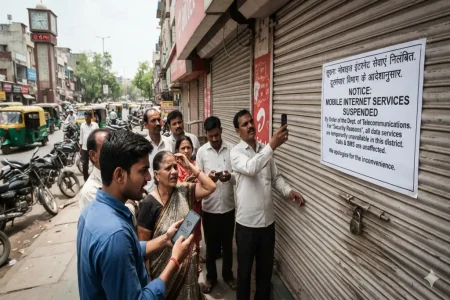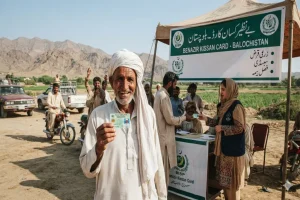
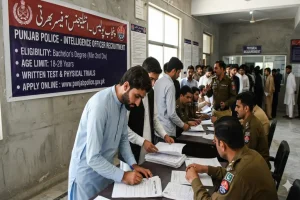


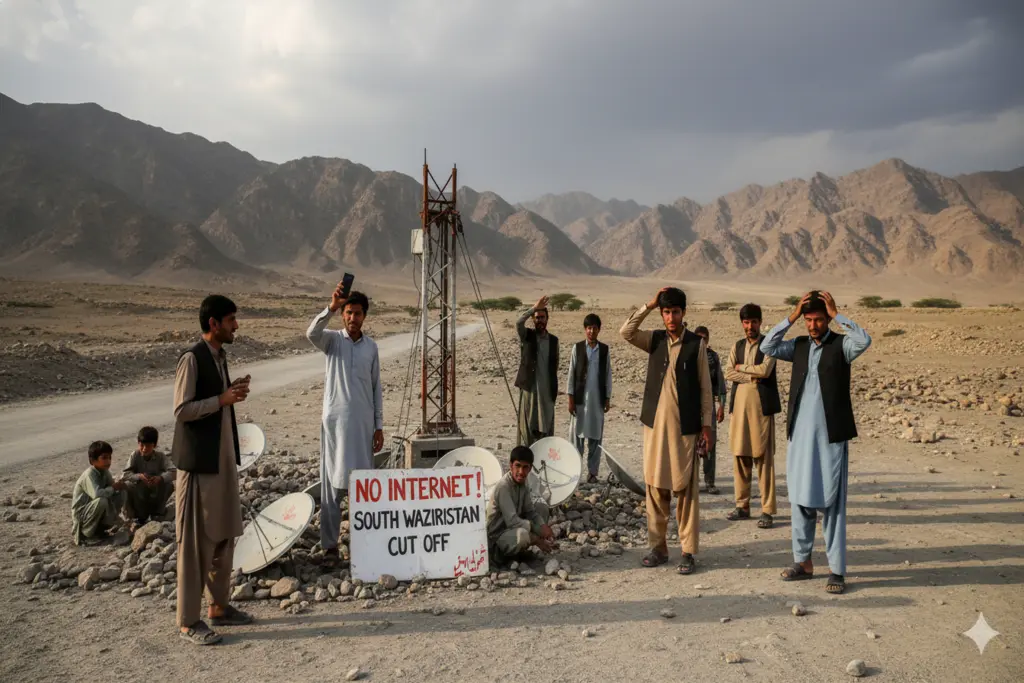
The local people in the tribal belt of Upper South Waziristan in Khyber Pakhtunkhwa have been facing communication blackout for more than 10 days, as they have no mobile network signal and internet connectivity in the area. The protest demonstration of the local youth, civil society, traders and tribal leaders took place in Sarvekai and Barwand areas of the district in response to this internet shutdown in South Waziristan. This sudden loss of cell connectivity has brought daily life to a standstill in today’s digital world, and also paralysed local businesses, suspended education online and prevented overseas workers from reaching out to their families right before the festive season of Eid ul Azha.
This detailed report includes all verified facts in the field, if you are in search of the exact reasons for the digital blackout, the affected territorial sectors as well as the current state of the network.
Technical Failure Behind the 10-Day Blackout
The recent 10-day complete blackout in Upper South Waziristan, following a serious transformation in the security landscape, is not a state imposed ‘security lockdown’ or a suspension of policies, according to field updates and local administrative sources. Rather, it is a significant technical failure of infrastructure in the region:
A mobile transceiver core backbone tower, driven by technical logs in the field, experienced a large and deep hardware fault at the Srarogha Ahmadwam location.
Cascading Downlink Phenomenon: This particular tower is used as a central transmission tower, and its failure caused a ripple effect, and completely cut the three other major cellular towers down the line. Consequently, nearby valleys’ signals fell to a dead low.
Historical Context versus Current Context: The past has seen law enforcement using temporary suspensions in mobile networks to thwart militancy threats during active security operations, but this is a result of the lack of timely maintenance of the infrastructure and negligence on the part of the private telecom companies.
Severely Impacted Sectors and Socio-Economic Hardships
The lack of mobile data and cell phone connectivity has essentially stopped communication in both the Upper and Lower subdivisions of South Waziristan:
In the Upper South Waziristan Zones (Upper SATA) of Sarvekai, Barwand, Srarogha, and neighboring rural areas, there have been no cellular bars and network identification for over a decade.
In the Lower South Waziristan Zones (WSZ) of Wana, Birmal, Tanai, Azam Warsak, Kalotai, Spin and Raghzai, data signals have been very weak, unstable or simply non-existent for almost two months.
Socio-Economic Impact of the Blackout
Disruption of Academic Activities: College and university students are completely unable to submit assignments, access examination schedules and required digital learning materials.
Paralysis of Financial Channels: Local merchant associations are suffering heavy financial losses due to the lack of functions of banking apps, mobile wallets (EasyPaisa and JazzCash) and digital transactions in the supply chain.
Pre-Eid Communication Barrier: Millions of workers who are employed in middle eastern countries or big cities in Pakistan are totally isolated and can’t receive remittance money or see how their families are doing before Eid.
Current Network Status and Restoration Demands
All the regular voice calling networks (3G/4G) of all major operators Jazz, Zong, Telenor and Ufone are presently down in these affected areas. Protest organizers and tribal elders have formally requested the federal government investigate this violation of basic digital rights, and require cellular companies to send engineering teams to fix broken transmission lines.