

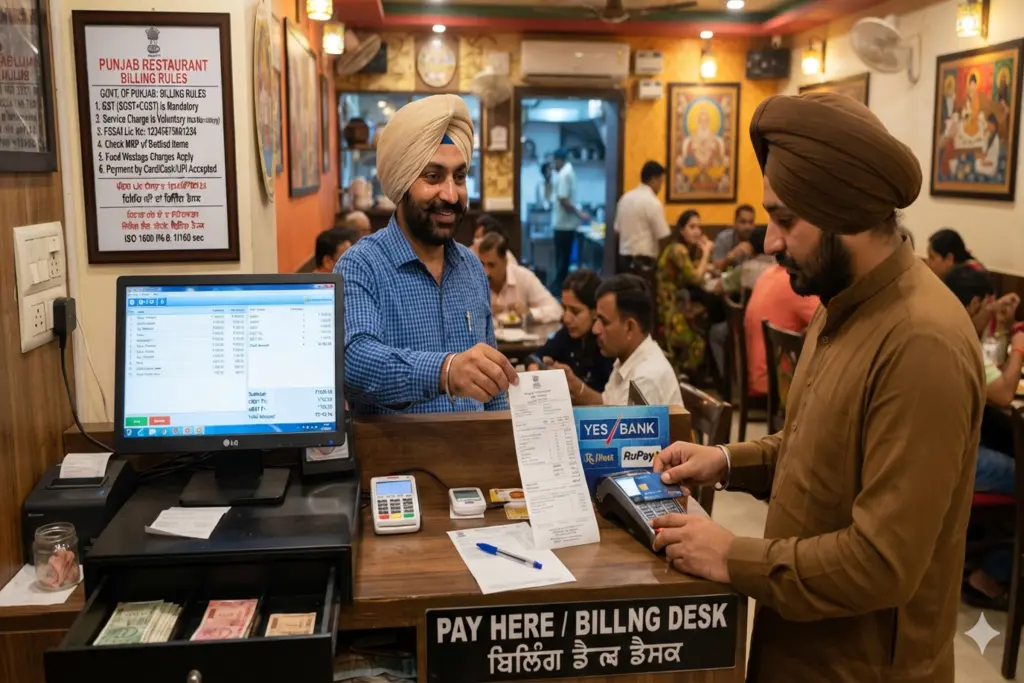
In a significant regulatory overhaul designed to curb tax evasion and bring financial transparency to the hospitality sector, the Punjab Revenue Authority (PRA) has officially enacted a stringent set of Punjab restaurant billing rules. The newly issued provincial notification mandates that all hotels, restaurants, cafes, fast-food outlets, and marriage halls across Punjab must completely cease the use of traditional handwritten slips, temporary chits, and raw unverified bills. Under the new Electronic Invoice Monitoring System (EIMS), every single food sale and dining transaction must be digitized and linked in real-time to the provincial revenue database.
Complete Ban on Handwritten Slips, Pre-Bills, and Kitchen Orders
The PRA has observed that many food establishments deliberately issue temporary receipts—such as Kitchen Order Slips (KOs), pre-bills, or plain paper notes—to avoid declaring actual sales volume. The new guidelines establish a strict framework for both business owners and diners:
Elimination of Provisional Bills: No restaurant is legally permitted to hand over a temporary slip or un-itemized chit as a final fiscal document to a customer.
Mandatory Guideline Displays: All culinary establishments, coffee shops, and bakeries are required to prominently display the new PRA guidelines at their billing counters and inside dining halls.
Customer Directives: Citizens are strongly encouraged to demand a formal computerized, digital tax receipt immediately upon completing their payment.
Compulsory PRA QR Codes and Detailed Digital Invoices
Under the updated provincial framework, a standardized compliance format has been introduced for all digital receipts. Before settling accounts, customers must verify that the bill features these three specific details:
Registration Credentials: The restaurant’s official commercial name, complete physical address, and unique Punjab Taxpayer Registration Number (PNTN/PTRN).
Explicit Tax Breakdown: A clear division displaying the pre-tax item total, the exact applicable sales tax rate, and the final net amount payable.
Scannable PRA QR Code: A certified invoice serial number paired with a functional QR code. Diners can use their smartphones to scan this code to instantly verify whether their paid tax has been successfully logged into the provincial exchequer.
Cash vs. Digital Payments: The Two-Tiered Tax Rate Strategy
To incentivize a digital, cashless ecosystem across the province, the Government of Punjab has introduced a distinct financial benefit for consumers. The sales tax rate on food bills is now directly determined by the customer’s chosen payment method:
Cash Payments: Settling a restaurant bill using physical cash incurs the full statutory sales tax rate of 16 percent.
Card and Digital Payments: Settling a bill using a debit card, credit card, mobile wallet, or digital banking QR code qualifies for a 50 percent tax reduction, dropping the applicable tax to just 8 percent.
The PRA has warned restaurant management teams that refusing to accept digital cards or online transfers is a serious offense that can be reported immediately by the customer.
Heavy Financial Penalties and Sealing of Non-Compliant Venues
To guarantee widespread enforcement, the PRA, alongside district management teams and tax officers, has mobilized field compliance units. Establishments operating outside the EIMS framework or issuing manual bills will face severe administrative punishments:
Financial Fines: A first-time billing violation will trigger immediate financial penalties ranging from Rs. 400,000 to Rs. 1,000,000.
Business Sealing: Repeated or persistent non-compliance will result in the food outlet or wedding hall being immediately sealed for up to one month.
Criminal Litigation: Any deliberate alteration of electronic sales data or obstruction of tax officials will lead to direct criminal prosecution under provincial revenue acts.
Citizens can instantly lodge complaints regarding non-compliant behavior through the official PRA Sahulat App or by sending a report via the dedicated regulatory WhatsApp channel.